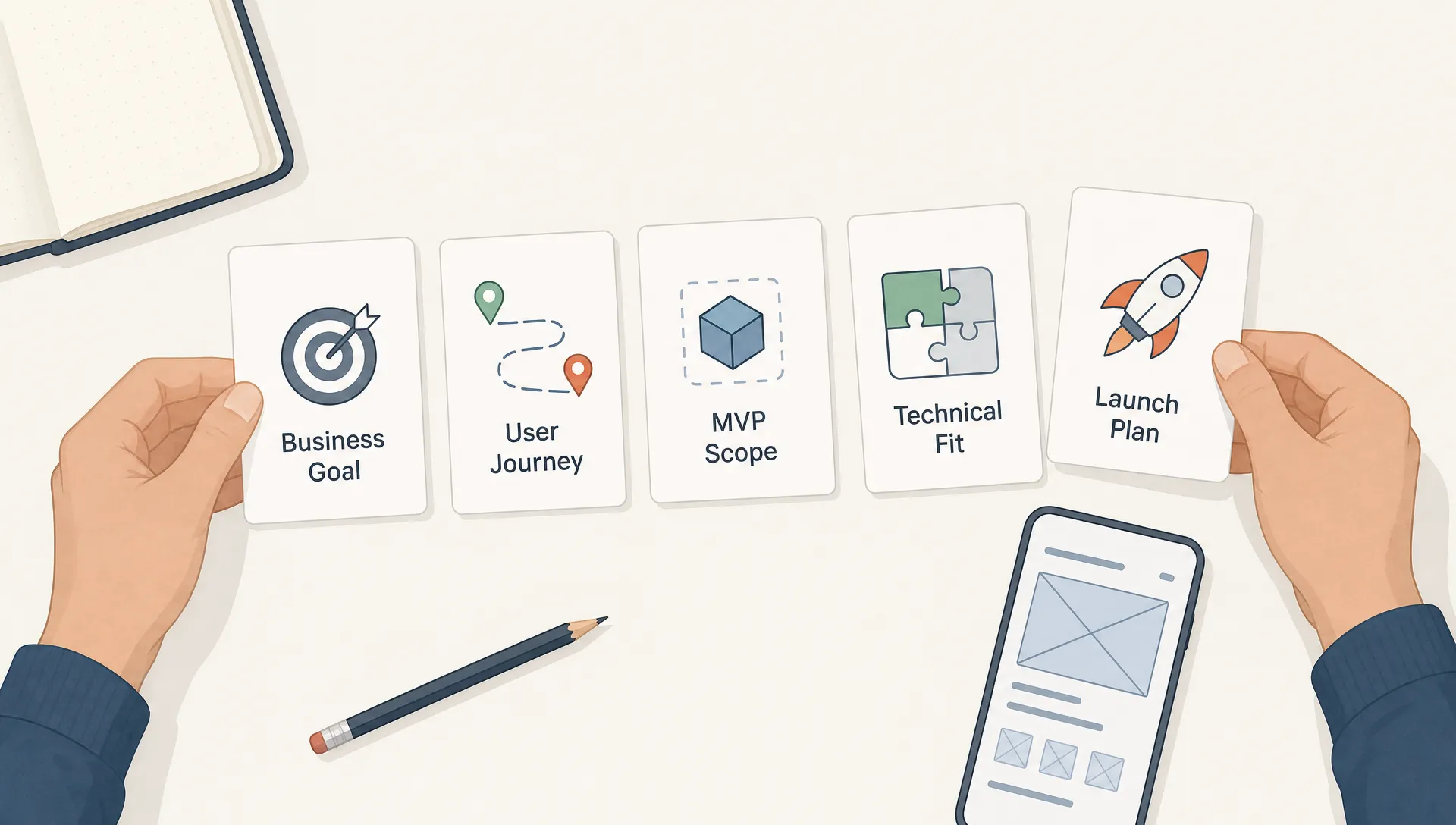

A Mobile App Discovery Process for Non-Technical Founders is the bridge between “I have an app idea” and “a developer can build this without guessing.” It turns rough notes, voice memos, competitor screenshots and business goals into a focused plan for the first version of your mobile app. For founders who do not write code, that clarity is what protects your budget, reduces rework and helps you move faster without building the wrong thing.
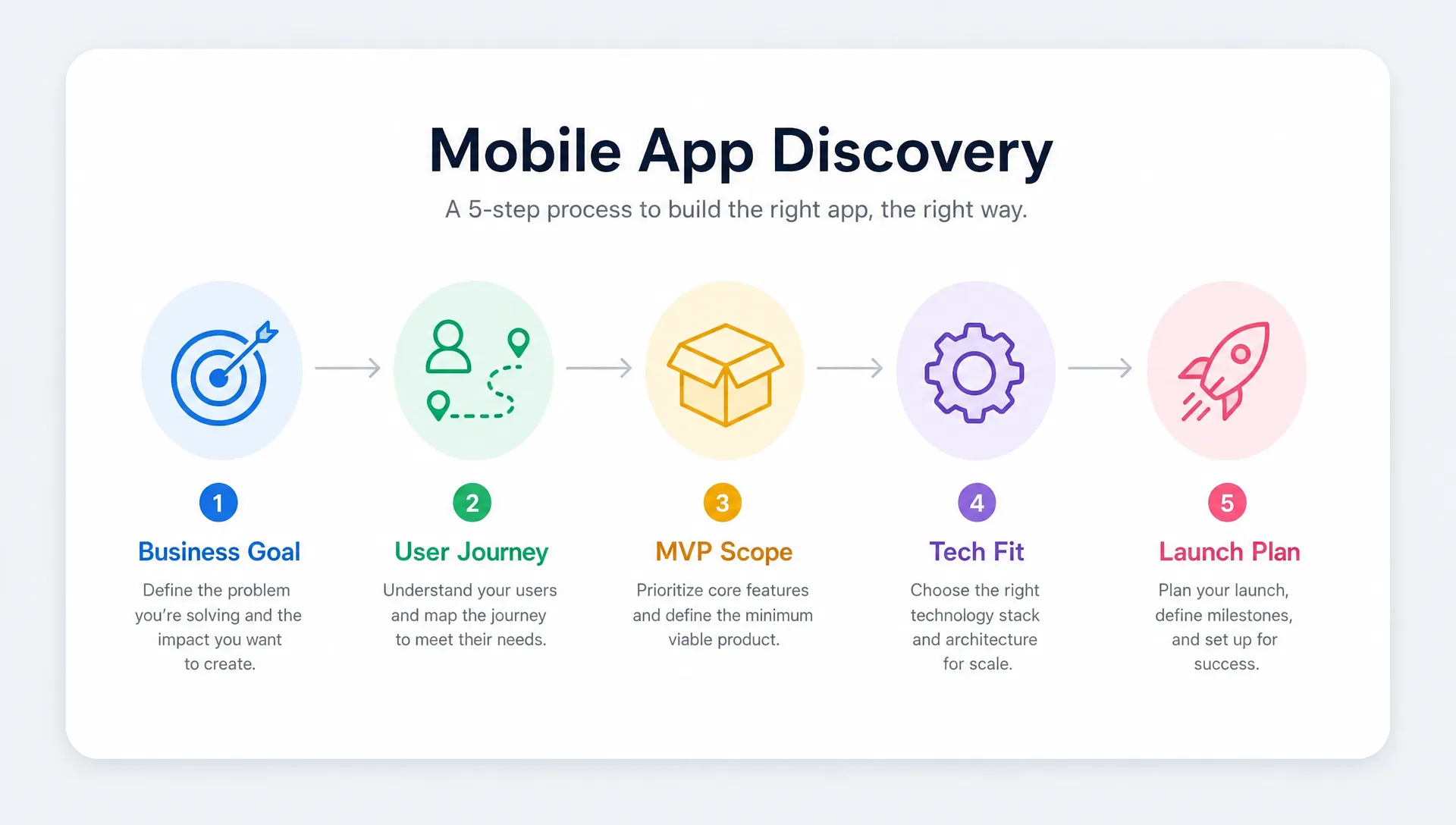
Discovery is not a long corporate workshop filled with jargon. Done well, it is a practical decision-making phase. You define who the app is for, what problem it solves, which features belong in the MVP, what technical risks exist and what the first launch should prove.
What a Mobile App Discovery Process for Non-Technical Founders Should Produce
The output of discovery should be build-ready enough that a mobile app developer can estimate, design and implement the MVP with fewer hidden assumptions. You do not need a full technical specification with every edge case solved, but you do need enough structure to prevent the project from becoming a moving target.
A strong mobile app discovery process usually produces these deliverables:
| Discovery output | What it answers | Why it matters |
|---|---|---|
| Business goal | What result should the app create? | Keeps features tied to revenue, operations or retention |
| Primary user profile | Who is the app for first? | Prevents trying to serve everyone at launch |
| Core user journey | What does the user need to do end to end? | Exposes missing screens and confusing steps early |
| MVP feature list | What must be in version one? | Controls timeline and budget |
| Technical notes | What platforms, integrations and data are needed? | Helps estimate accurately |
| Launch assumptions | What needs to be true for the MVP to succeed? | Gives the first release a clear test |
For a non-technical founder, the goal is not to become a product manager overnight. The goal is to make clear decisions before development begins.
Step 1: Translate the Idea Into a Business Outcome
Many app ideas start as a feature list: login, chat, profiles, payments, booking, notifications and admin panel. That is understandable, but it is not the best starting point. Discovery should begin with the business outcome.
Ask what should improve after the app launches. A local service business may want fewer phone calls and better appointment scheduling. A healthcare startup may want patients to complete intake forms before a visit. A study app may want users to finish more practice sessions each week. An internal operations app may need to replace paper logs and reduce missed updates.
This framing helps you avoid building features just because other apps have them. If the outcome is faster job dispatch for a field service team, a beautiful social feed is irrelevant. If the outcome is paid subscriptions, onboarding, pricing and retention need early attention.
A good discovery conversation should make the business case plain enough that every later decision can be judged against it.
Step 2: Define the First User, Not Every Possible User
A mobile app discovery process becomes much simpler when you choose one primary user for the first release. Non-technical founders often describe several audiences at once: customers, staff, managers, vendors and admins. Those users may all matter eventually, but trying to serve all of them in version one can triple the scope.
Start with the user who creates the most important proof for the business. For a marketplace, that might be the buyer if demand is uncertain. For a clinic workflow app, it might be the front desk team if the first pain point is intake management. For a consumer app, it may be the end user who needs to form a habit before any advanced monetization matters.
At this stage, talk to real potential users if you can. If you have not validated the demand yet, use interviews, simple prototypes or a landing page before committing to a build. The guide on validating your app idea before building an MVP covers that step in more detail.
Step 3: Map the Core User Journey Before Listing Features
Once the first user is clear, map the path they take from problem to outcome. This should be written in plain English before anyone opens a design tool.
For example, a booking app journey might look like this: a customer finds a service, chooses a time, enters details, confirms the booking, receives reminders and can reschedule if needed. That simple journey already suggests screens, data fields, notifications and edge cases.
This is where non-technical founders gain leverage. You do not need to know how push notifications are implemented, but you should know when a reminder should be sent and what the user needs to do after receiving it.
A useful test is to remove every feature that does not support the core journey. If the user can reach the desired outcome without it, the feature may belong in a later release.
Step 4: Separate the MVP From the Future Roadmap
The hardest part of discovery is not coming up with features. It is saying “not yet” to good ideas that do not belong in the first launch. A focused mobile app discovery process helps founders protect the MVP from becoming a full product before it has proven demand.
Use three practical buckets:
- Must have: The app cannot deliver the core outcome without this.
- Should have later: Valuable, but not required to test the first business assumption.
- Avoid for now: Nice to have, distracting or dependent on user behavior you have not confirmed.
For example, a trades business replacing paper job sheets may need login, job assignment, notes, photos and completion status. Advanced analytics, customer portals and AI-generated reports may be useful later, but they may not be needed to prove the first workflow.
If you want a deeper framework, the article on how to scope an MVP app in 6 simple steps is a useful companion to the discovery phase.
Step 5: Choose Platforms and Technical Direction Early
Platform decisions affect budget, timeline and user experience. Non-technical founders do not need to decide alone, but discovery should clarify the options.
If your users are mostly on iPhone and the first release depends heavily on Apple-specific features, native iOS may be worth considering. If you need iOS and Android quickly, cross-platform apps can reduce duplicated work by sharing a codebase. Flutter and React Native are common choices for startups because they can support both platforms while keeping the team lean.
This decision should be based on the product, not on trend-chasing. A simple MVP for both iOS and Android may be a strong fit for cross-platform development. A complex app with deep native integrations may need more careful planning.
For founders comparing speed, cost and maintainability, the guide on developing a cross-platform mobile app faster explains how scope and architecture affect delivery.
Step 6: Identify Data, Privacy and Compliance Requirements
Data questions should come up during discovery, not after the app is built. This is especially important for healthcare, fintech, education, location tracking, AI features and apps that collect sensitive personal information.
A healthcare app may need HIPAA-aware planning in the United States if it handles protected health information. The U.S. Department of Health and Human Services explains the HIPAA Security Rule, including safeguards for electronic protected health information. If your app serves users in the European Union or processes EU personal data, GDPR requirements may also affect consent, data access and retention.
Even simple apps need privacy decisions. What information do you collect? Why do you need it? Who can access it? How long is it stored? Apple and Google also expect apps to disclose data practices, with Google Play requiring developers to complete a Data safety section.
Discovery should not replace legal advice, but it should flag compliance risks early enough to avoid expensive rebuilds.
Step 7: Turn the Journey Into Wireframes and Acceptance Criteria
Wireframes are simple screen layouts that show what each screen contains and how users move through the app. They do not need polished colors, branding or animations. Their purpose is to make the product visible before development starts.
For non-technical founders, wireframes are often the first moment when vague features become concrete. You may realize the sign-up flow asks for too much information, the booking screen needs fewer steps or the admin side is more complex than expected.
Pair the wireframes with acceptance criteria. These are plain-language rules that define when a feature is complete. For example: “A customer can select an available time slot and receive a confirmation screen after booking.” That sentence gives the developer, designer and founder the same target.
This reduces subjective feedback later. Instead of saying “the booking feature feels unfinished,” you can compare it against the agreed criteria.
Step 8: Estimate Timeline, Budget and Build Milestones
The final stage of the mobile app discovery process is turning decisions into an execution plan. A developer should be able to look at the MVP scope, wireframes, platform choice, integrations and compliance notes, then explain what can be built first and what should wait.
If your goal is a 4-6 week MVP, the scope needs to be intentionally small. That does not mean low quality. It means the first release should focus on the smallest product that can test the business assumption with real users.
A practical milestone plan might include setup and architecture, core screens, backend and integrations, testing, App Store and Google Play preparation, then post-launch fixes. The exact plan depends on the app, but the founder should understand what will be delivered each week.
Discovery is also the right time to discuss ownership of code, app store accounts, analytics, documentation and support after launch. These details are easy to ignore during the excitement of starting a build, but they matter once users arrive.
Questions to Answer Before Your First Discovery Call
You do not need perfect answers before speaking with a mobile app developer. Rough notes are enough. Still, preparing a few basics will make the discovery call more productive.
- What problem does the app solve in one sentence?
- Who is the first user group the MVP should serve?
- What are users doing today instead of using your app?
- What action should a user complete in the first session?
- Do you need iOS, Android or both at launch?
- Will the app collect payments, health data, location data or personal documents?
- What would make the first version successful after 30 to 90 days?
These questions keep the conversation grounded. They also help reveal whether the next best step is validation, scoping, design or development.
Common Discovery Mistakes Non-Technical Founders Can Avoid
The most common mistake is treating discovery as a formality. If the scope is unclear, development becomes discovery by accident, which is usually more expensive.
Another mistake is copying a competitor feature for feature. Competitor research is useful, but your MVP should focus on your first customer segment and business model. A mature competitor may have spent years adding features that your first version does not need.
Founders also underestimate admin tools. Many apps need some way to review users, manage content, handle bookings, update records or respond to issues. If the admin workflow is ignored during discovery, it often becomes a surprise cost later.
Finally, avoid making platform decisions only based on personal preference. The right choice depends on your users, budget, feature complexity and launch goals. Discovery should turn those tradeoffs into a decision you understand.
Ready to Turn Your App Idea Into a Buildable MVP?
A clear discovery process gives non-technical founders the confidence to move from idea to execution without pretending to be technical. It helps you define the first version, choose the right platform and give your developer the context needed to build efficiently.
If you are planning an iOS, Android or cross-platform MVP, you can book a consultation call to discuss the best path from discovery to launch. Bring the idea, the business goal and the users you want to serve first. The next step is turning that into a practical build plan.