
An app idea can feel obvious when you are close to the problem. A local contractor knows scheduling is messy. A clinic knows intake forms are slow. A founder sees how AI could automate a repetitive workflow. The temptation is to hire a mobile app developer, build the MVP and see what happens.
That order is risky.
Validation should happen before MVP development because an MVP is still a real investment of time, money and attention. The goal is not to prove your idea will become a unicorn. The goal is to reduce the biggest unknowns before you write production code.
For non-technical founders, small business owners and early-stage startups, a good validation process answers one practical question: is this problem painful enough that a specific group of people will change their behavior to solve it?
What validating an app idea really means
Validating an app idea does not mean asking friends if they like it. Most people are polite. They will say an idea sounds useful, especially when there is no cost, no account setup and no need to replace their current workflow.
Real validation looks for evidence of behavior. Did someone agree to a follow-up call? Did they share their current spreadsheet? Did they join a waitlist from a cold landing page? Did a business owner ask whether they could use it next month? Did a clinic explain the compliance process you would need to pass before adoption?
CB Insights has listed “no market need” as one of the most common reasons startups fail. That is why validation is less about enthusiasm and more about finding market pull before you commit to a build.
| Validation is | Validation is not |
|---|---|
| Testing whether a real user has a painful problem | Asking friends if your idea sounds cool |
| Learning how people solve the problem today | Starting with a feature list |
| Checking if users will take action | Counting vague compliments |
| Finding the smallest useful product | Building a polished app immediately |
| Reducing risk before spending on development | Guaranteeing success |
A validated app idea still needs strong execution, clean design and a realistic launch plan. But if validation shows the problem is weak, vague or already solved well enough, you can save yourself months of avoidable work.
Start with the riskiest assumption
Every app idea has assumptions. Some are minor, such as whether the settings screen should include dark mode. Others can kill the business if they are wrong.
Before building an MVP, identify the assumption that would make the whole project fail if it turned out false. For most early app ideas, that assumption falls into one of five categories:
- Problem risk: The problem is not painful enough.
- Audience risk: You are targeting the wrong user.
- Behavior risk: Users will not change from their current process.
- Revenue risk: Users will not pay, or the buyer is not the same as the user.
- Feasibility risk: The product depends on integrations, compliance, AI accuracy or data access that may be harder than expected.
A trades business app might have behavior risk because workers are used to paper job sheets. A healthcare app may have feasibility and compliance risk because patient data requires serious privacy controls. An AI lead generation tool may have accuracy risk because bad leads are worse than no leads.
| App idea type | Risky assumption to validate first | Simple validation test |
|---|---|---|
| Field service scheduling app | Crews will use a mobile workflow instead of paper | Shadow the current process and test a clickable job flow |
| Healthcare intake app | Clinics need a better intake process and can adopt it compliantly | Interview admin staff and ask about HIPAA, GDPR or procurement requirements |
| AI lead generation app | The AI can produce leads that sales teams actually trust | Run a manual lead research test and compare results with the current process |
| Fitness coaching app | Users will log activity consistently enough to get value | Test a lightweight habit flow with a small group for one week |
| Study companion app | Students need help with a specific study moment, not a generic tool | Interview students around exam prep, homework and focus struggles |
You do not need to test every assumption at once. Start with the one most likely to sink the idea.
Turn the idea into a clear hypothesis
A broad idea is hard to validate. “An app for local gyms” could mean booking classes, tracking workouts, managing trainers, selling memberships or building a fitness community.
A hypothesis makes the idea testable. Use this format:
For [specific user], who struggles with [specific problem], this app helps them [specific outcome] by [specific workflow]. We will know it matters if they [specific action].
For example:
For independent HVAC business owners, who struggle to track job status across technicians, this app helps them assign and update jobs from a phone. We will know it matters if at least five owners agree to test a prototype using one real job workflow.
That sentence forces clarity. You know who to talk to, what problem to explore, what workflow to test and what behavior would count as progress.
If you cannot write a focused hypothesis, you are probably not ready to build an MVP. You may still have a promising direction, but it needs sharper definition.
Interview real users before you pitch the product
Customer interviews are one of the cheapest ways to avoid building the wrong thing. The key is to ask about the user’s current behavior, not their opinion of your imagined app.
Bad validation questions sound like this: “Would you use an app that does X?” or “Would you pay for this?” People can say yes without meaning it.
Better questions focus on what already happened:
- “When was the last time this problem happened?”
- “What did you do to solve it?”
- “How much time or money did it cost?”
- “Who else was involved in the process?”
- “What tools do you use today?”
- “What happens if the problem does not get solved?”
- “Have you paid for anything to fix this before?”
- “Can you show me how you handle it now?”
For a local business, that might mean watching how appointment requests move from phone calls to sticky notes to a calendar. For a healthcare workflow, it might mean understanding who collects patient information, where it is stored and what compliance steps are non-negotiable. For an AI automation idea, it may mean learning which parts of the task require judgment, review or human approval.
Aim for patterns, not one-off comments. If 10 business owners describe the same painful workaround without being prompted, you have a stronger signal than one enthusiastic conversation.
Test demand before writing code
Once you understand the problem, test whether users will take a small action. The action should match the seriousness of the product. A consumer app might start with a waitlist. A B2B app may need booked discovery calls, pilot commitments or letters of intent. A healthcare product may need stakeholder interest plus a clear path through compliance review.
| Validation method | What it tests | Best for |
|---|---|---|
| Landing page | Whether the message resonates with a target audience | Early demand testing and lead generation |
| Waitlist | Whether people want updates or early access | Consumer apps, local services and simple SaaS ideas |
| Clickable prototype | Whether the workflow makes sense before code | Mobile apps with important UX decisions |
| Concierge test | Whether the outcome is valuable when delivered manually | AI automation, operations tools and service marketplaces |
| Pilot commitment | Whether a business will seriously evaluate the product | B2B, healthcare, trades and internal workflow apps |
A concierge test is especially useful for AI automation ideas. Instead of building the AI system first, deliver the result manually for a few users. If no one values the output when a human does it well, automating it will not fix the demand problem.
For example, if you want to build an app that sends qualified leads to local roofers, you can manually research leads, package them in the format you imagine and ask roofers to review quality. Their response will teach you more than a polished dashboard would at this stage.
Validate the core workflow, not every feature
A mobile app lives or dies by its main workflow. For an MVP, that workflow is usually one path: sign up, create a request, assign a job, upload a document, track a habit, send a message or complete a booking.
You do not need push notifications, admin analytics, profile customization and referral systems to validate the first version. You need to know whether the central action is useful, understandable and worth repeating.
A simple prototype can be enough. It can be a Figma file, a clickable mockup or even a paper sketch. The goal is to watch users move through the concept and listen for friction. Where do they hesitate? Which labels confuse them? Which steps feel unnecessary? What information do they expect to see before they trust the app?
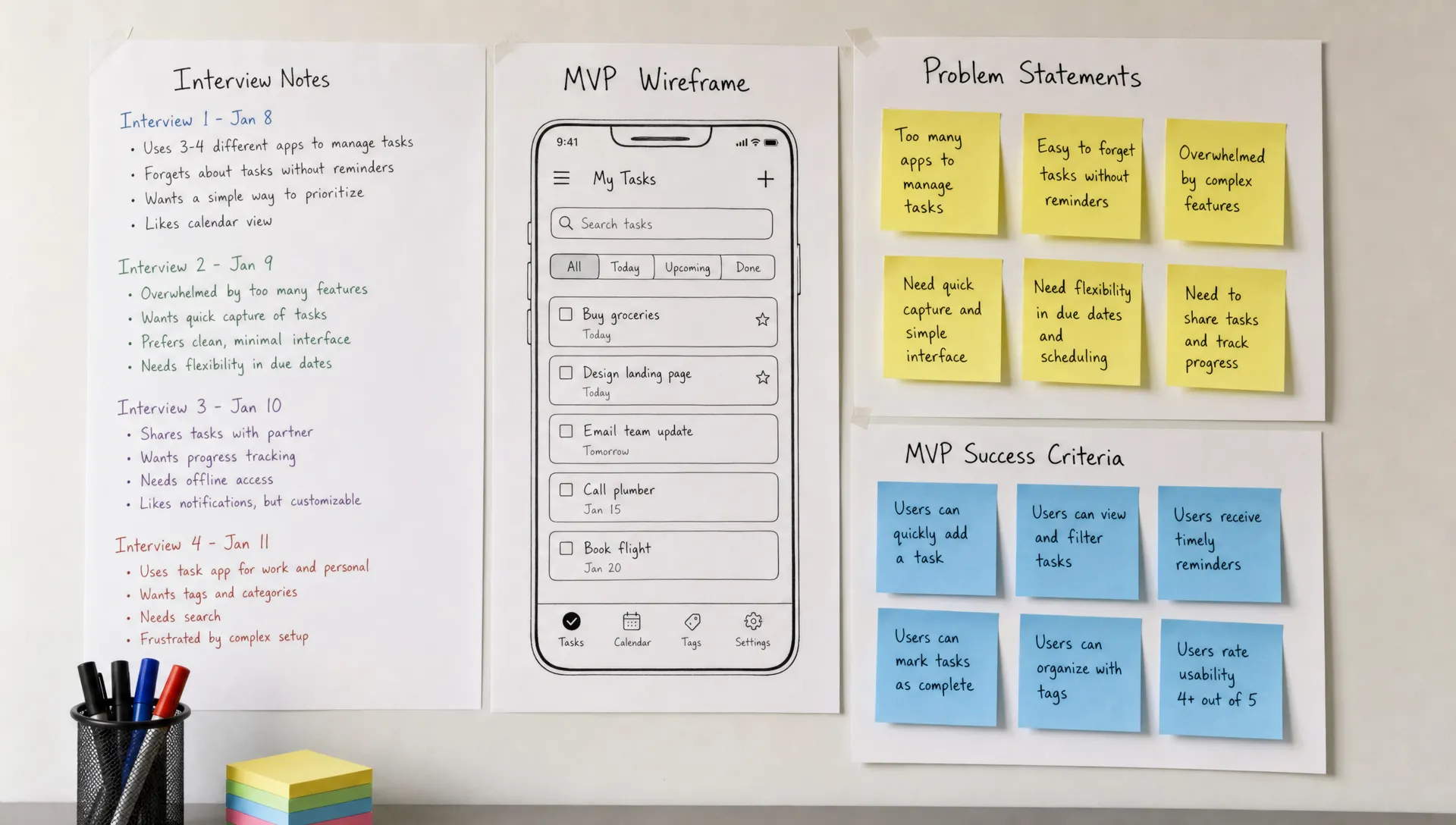
This is where many founders accidentally expand scope. A user says, “It would be nice if it also did invoicing,” and the MVP suddenly becomes a full business management suite. Treat feature requests as clues, not instructions. Ask why the feature matters and whether it supports the core workflow.
If the validation work shows a clear path forward, you can move from evidence to structure. A practical next step is to scope the MVP app around the smallest useful workflow instead of turning every request into version one.
Set success criteria before you run the test
Validation becomes messy when you decide what the results mean after seeing them. Set criteria first so you can make a clearer decision.
Your criteria do not need to be complicated. They should match the stage of the idea and the type of user. A founder testing a consumer habit app may care about repeat usage. A business app may care about booked calls and pilot interest. A healthcare app may need stakeholder interviews that confirm both need and adoption path.
| Signal | Weak evidence | Stronger evidence |
|---|---|---|
| Interview feedback | “That sounds interesting” | User describes the problem in detail and shows the current workaround |
| Waitlist | Signups from friends | Signups from target users who came from a clear message or campaign |
| B2B interest | A general “keep me posted” | A booked follow-up with the person who owns the process or budget |
| Pricing | User says they might pay | User compares it to an existing cost, budget or paid workaround |
| Prototype test | User clicks through politely | User asks when they can try it with real data |
For early validation, you are looking for directional evidence. If the signals are mixed, do not force a build. Narrow the user group, sharpen the problem and test again.
Check feasibility before committing to MVP development
A validated problem still needs a buildable solution. Before you hire or start development, review the technical, legal and commercial constraints that could affect scope.
For mobile app ideas, the biggest feasibility questions often include:
- Platform choice: Do you need iOS, Android or both at launch?
- Data requirements: What data do you collect, store and process?
- Integrations: Do you depend on calendars, payments, maps, EHR systems, CRMs or third-party APIs?
- Compliance: Does the app involve health data, financial data, children’s data or location tracking?
- AI reliability: Does an AI feature need human review, audit logs or confidence checks?
- Offline use: Will field teams need the app in areas with poor connectivity?
Healthcare products deserve extra caution. If your app handles protected health information in the United States, HIPAA may apply. If you serve users in the European Union or process personal data from EU residents, GDPR may apply. Validation should include these constraints early because compliance can change the MVP architecture, user permissions, logging and vendor choices.
Platform choice also matters. Many startups and small businesses want both iOS and Android without funding two separate native builds. In that case, cross-platform apps can be a strong option after the idea is validated. If speed is a priority, this guide on developing a cross-platform mobile app faster explains how scope, reusable patterns and technical choices affect delivery time.
A short feasibility review with a mobile app developer can help you avoid validating a workflow that later turns out to be too expensive for your first release.
Decide whether to build, narrow, pivot or stop
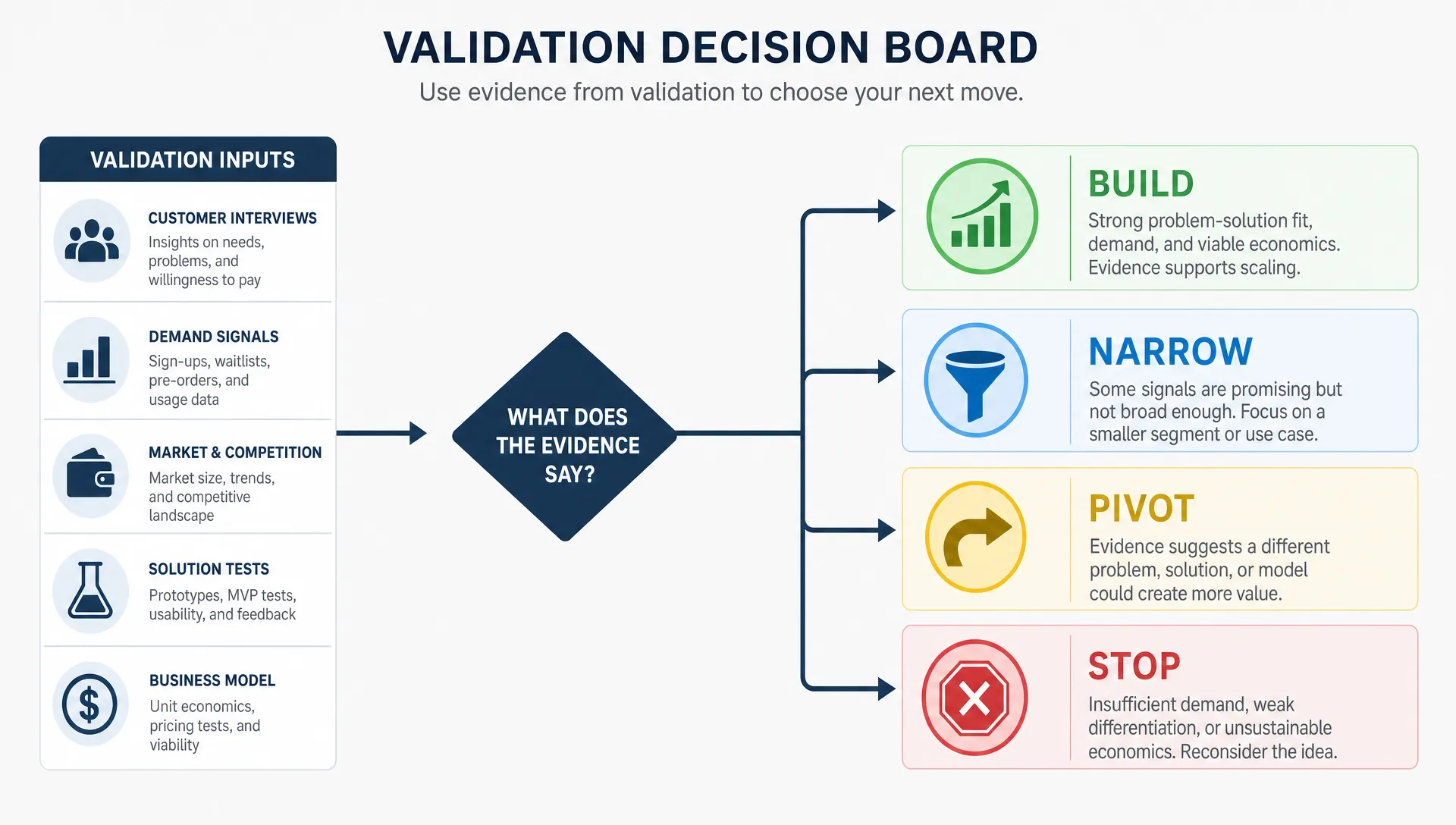
The point of validation is to make a decision. After interviews, demand tests and prototype feedback, place the idea into one of four buckets.
| Result | What it means | Next step |
|---|---|---|
| Build | Users have a painful problem and took meaningful action | Define MVP scope and development plan |
| Narrow | The problem is real, but the audience or workflow is too broad | Focus on one user type and one core use case |
| Pivot | A different problem appeared more urgent than your original idea | Rewrite the hypothesis and validate again |
| Stop | Users do not care enough to change behavior | Save the budget and move to a better opportunity |
Stopping is not failure. It is a successful validation outcome if it prevents you from building an app nobody needs.
Narrowing is often the best outcome. A founder may start with “an app for home service businesses” and discover the strongest need is “a mobile job checklist for small HVAC teams doing recurring maintenance.” That narrower idea is easier to design, easier to sell and easier to build as an MVP.
Common validation mistakes to avoid
Many founders do some validation but still end up with weak evidence. These are the traps to watch for.
- Only talking to friends: Friends are useful for encouragement, not reliable market evidence.
- Pitching too early: If you explain the app before understanding the current problem, you bias the conversation.
- Confusing interest with intent: A compliment is not the same as a signup, meeting, pilot or payment.
- Testing too many audiences: If you interview students, clinics, coaches and small retailers in the same week, the patterns will be noisy.
- Skipping the buyer: In B2B and healthcare, the user may not control the budget.
- Building the prototype too polished: A beautiful mockup can make people react to design instead of the problem.
- Ignoring operational details: Support, onboarding, data entry and compliance can decide whether a product gets adopted.
The best validation process feels slightly uncomfortable because it exposes your idea to reality before you are emotionally and financially committed to a build.
Ready to validate and build the right MVP?
Validation helps you avoid the most expensive mistake in app development: building a polished product for a weak problem. Once you have evidence, the next step is turning that evidence into a focused MVP that can ship quickly, gather real usage data and improve from there.
If you are a founder or business owner with a validated app direction, I build iOS and Android mobile apps, cross-platform apps and focused MVPs for startups and clients. You can book a consultation call to review your idea, clarify scope and plan a practical first version that can be built without unnecessary features.