
Hiring a developer is easy. Hiring the right developer, with the right scope, contract, budget and communication rhythm, is where most expensive mistakes happen.
For a founder or small business owner, a mobile app is often not just a side project. It may be the first version of a startup, a replacement for paper-based operations, a booking tool for field teams or a patient-facing healthcare product. A bad hire can leave you with unfinished code, unclear ownership, weak security or an app that technically works but nobody wants to use.
The goal is not to become a technical expert before you hire a mobile app developer. The goal is to know enough to judge whether someone can turn your business problem into a reliable iOS and Android product without wasting months of budget.
Start with the business result, not the app idea
Most hiring conversations start too vaguely: “I need an app like Uber for my industry” or “I want an app for my customers.” That makes it difficult for a developer to estimate accurately and easier for the project to expand in every direction.
A stronger starting point is a clear business outcome. For example, a local service company might want to reduce missed appointments. A clinic might want to collect intake information securely before a visit. A startup founder might want to validate whether users will pay for a new social, study or fitness experience.
Before speaking with developers, write down:
-
The specific user problem the app will solve
-
The first user group you want to serve
-
The action you want users to complete in the app
-
The business metric that would make the first version successful
-
The features that can wait until after launch
This matters because mobile app development is full of tradeoffs. A developer who understands the business goal can help you cut the wrong features early, choose a practical platform strategy and protect your budget.
| Common hiring mistake | Why it becomes expensive | Better approach |
|---|---|---|
| Starting with a long feature wishlist | Every extra feature adds design, development and testing work | Define the smallest useful version first |
| Choosing only by hourly rate | Low rates can hide weak process, slow delivery or poor code quality | Compare value, communication and past outcomes |
| Skipping technical ownership terms | You may not fully own the source code or assets | Put IP ownership in the contract |
| Ignoring compliance early | Retrofitting privacy and security can be costly | Discuss data handling before development starts |
| Accepting vague timelines | Unclear milestones make delays harder to manage | Tie payments and reviews to concrete deliverables |
Decide what kind of mobile app developer you actually need
Not every project requires the same kind of hire. A polished consumer app, an internal operations app and a healthcare product all have different risks. The right fit depends on your stage, budget, technical needs and how much guidance you need.
A solo freelance mobile app developer can be a strong option when you need focused execution, fast iteration and direct communication. This is often a good fit for MVPs, local business apps and early versions where the scope is clear enough to build quickly.
An agency may make sense for larger products that need several specialists at once, such as strategy, branding, UX research, backend engineering, QA and long-term support. The tradeoff is usually higher cost and more layers of communication.
An in-house developer is better when mobile is core to the business and you need continuous product development after launch. For most early-stage founders, hiring full-time before validating the product can be premature.
| Hiring option | Best for | Watch out for |
|---|---|---|
| Freelance mobile app developer | MVPs, startup prototypes, small business apps and direct collaboration | Make sure process, testing and code handoff are clear |
| App agency | Larger builds with design, backend and QA teams | Higher cost and less direct access to the builder |
| In-house developer | Ongoing product teams after traction | Payroll cost before product-market fit |
| No-code builder | Simple internal tools or validation prototypes | Limits on performance, customization and app store readiness |
| Specialist consultant | Security, HIPAA, GDPR or architecture reviews | Usually not a full build partner |
If you are still weighing hiring models, this guide on how to choose a mobile app developer for your startup goes deeper into product thinking, platform decisions and founder-developer fit.
Turn your concept into a realistic MVP scope
A costly mistake is asking developers to estimate a product that is not defined. If five developers receive five different versions of your idea during calls, their quotes will not be comparable.
You do not need a 60-page specification document. You do need enough clarity to separate must-have features from “nice later” features. A practical MVP scope usually includes the core user journey, basic account flows, essential data storage, the main screen structure and any required integrations.
For example, a fitness app MVP may only need onboarding, workout plans, progress tracking and reminders. A study app might start with notes, quizzes and a simple review schedule before adding AI personalization. A field service app may begin with job assignment, photo uploads and status updates rather than advanced routing, invoicing and analytics.
A good developer should help you reduce scope without weakening the product. If every requested feature is accepted without challenge, that is not always a good sign. Experienced builders know that the first release is a learning tool, not a monument.
For a more complete planning process, review this guide to building a mobile app that users want before you request quotes.
Evaluate portfolios beyond screenshots
A portfolio can look impressive and still tell you very little. Beautiful screens do not prove that the developer can manage state, handle edge cases, structure clean code or ship through the app stores.
When reviewing past work, ask what the developer personally contributed. Did they build the full app, only the frontend or only a few screens? Did they work with an existing team or own the entire delivery? Was the app released publicly? Did it include authentication, payments, messaging, maps, offline use, notifications or admin workflows?
If you are a non-technical founder, ask for a plain-English walkthrough of one project. Listen for how they explain decisions. Strong developers can describe tradeoffs without burying you in jargon. They should be able to explain why they chose a framework, how they handled testing, what changed during the project and what they would improve if they rebuilt it.
For small businesses, industry context matters too. A booking app for a salon is different from a job tracking app for HVAC technicians. A secure client intake app for a personal injury practice has different privacy expectations than a public marketing app. The developer does not need to know every detail of your industry on day one, but they should ask smart questions about users, workflows and sensitive data.
Ask questions that reveal process, not just skill
The best interview questions help you understand how the developer thinks under real project conditions. You are not only buying code. You are buying judgment, communication and the ability to make decisions when requirements change.
Useful questions include:
-
How would you turn this idea into a 4-6 week MVP?
-
What features would you cut from the first version and why?
-
Which parts of this app are most likely to affect budget or timeline?
-
How do you handle app store submission and review issues?
-
How do you test on iOS and Android devices?
-
What happens if we discover a major scope change halfway through?
-
How will I access the source code and project assets?
-
What support do you provide after launch?
Pay attention to specificity. A weak answer sounds like “no problem, we can do everything.” A better answer explains what is straightforward, what is risky and what needs more definition before the estimate is reliable.
Understand pricing before you compare quotes
The cheapest quote is not always the cheapest project. If a developer underestimates the work, you may pay later through delays, rushed code, missing features or a rebuild.
Mobile app pricing depends on scope, design quality, platform choice, backend complexity, integrations, compliance needs and support expectations. A simple content or booking app costs much less than a social app with messaging, feeds, moderation, push notifications and real-time updates.
Ask each developer to separate the estimate into clear parts. Even if they charge a fixed project price, you should understand how much effort goes into discovery, design, frontend development, backend work, testing, deployment and post-launch fixes.
You should also ask what is excluded. Common exclusions include paid third-party services, app store fees, copywriting, ongoing server costs, analytics tools, advanced admin dashboards and maintenance after the warranty period.
If you are budgeting specifically for Apple devices, this breakdown of iOS app development costs can help you understand what affects founder budgets in 2026.
Protect yourself with a clear contract
A handshake agreement is not enough for a serious app build. Even a small MVP should have a written agreement that defines scope, ownership, payments and responsibilities.
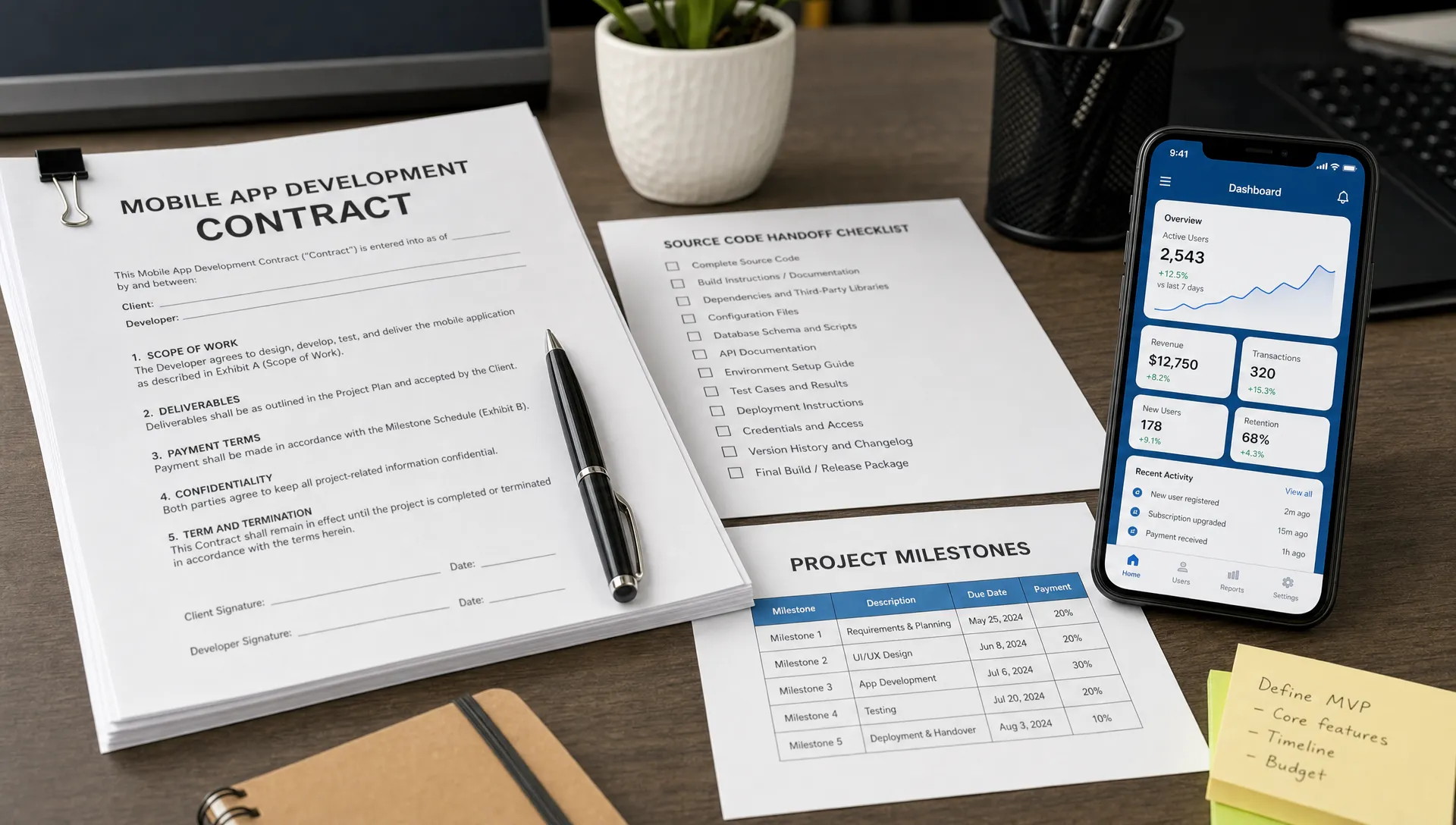
At minimum, your contract should cover the project deliverables, payment schedule, change request process, intellectual property ownership, confidentiality, third-party tools and post-launch support. If you are handling sensitive data, the contract should also address privacy and security responsibilities.
For healthcare software, compliance needs to be discussed before development starts. In the United States, apps that handle protected health information may need to account for HIPAA obligations. If you serve users in the European Union or process EU personal data, GDPR requirements may apply. A developer is not a substitute for legal counsel, but they should understand privacy-by-design principles and be willing to work within compliance requirements.
| Contract item | What to clarify before work begins |
|---|---|
| Scope of work | Screens, features, platforms, integrations and deliverables |
| Payment milestones | What must be completed before each payment |
| Source code ownership | Who owns the code, repositories and app store assets |
| Change requests | How new features or revisions are priced and approved |
| Confidentiality | How business ideas, user data and internal documents are protected |
| Post-launch support | Bug fix window, maintenance terms and response expectations |
| Compliance responsibilities | Data storage, access controls, audit needs and legal review points |
Watch for technical and communication red flags
You do not need to read code to spot risk. Many warning signs appear in how the developer communicates before the contract is signed.
Be careful if a developer promises an exact timeline without asking detailed questions. A confident estimate is useful, but certainty before discovery usually means they have not considered edge cases. You should also be cautious if they avoid discussing testing, refuse to explain their process or cannot describe how they handle bugs after launch.
Another red flag is platform confusion. If you need both iOS and Android, the developer should explain whether they recommend cross-platform development or separate native apps. Cross-platform frameworks can be excellent for MVPs because they reduce duplicated work, but the decision should still be tied to performance needs, user experience and long-term plans.
Also look for ownership clarity. You should not be dependent on a developer who keeps everything in a private account with no clear handoff plan. For a serious business app, you need access to source code, design files, app store accounts and critical documentation.
Use a simple hiring workflow
A structured hiring process reduces emotion and makes developer comparisons easier. You do not need a corporate procurement process, but you should avoid hiring solely because a call “felt good.”
A practical workflow looks like this:
-
Define the business goal, target users and MVP feature set.
-
Shortlist developers with relevant mobile experience and past shipped work.
-
Send the same project summary to each candidate.
-
Hold a discovery call focused on scope, risks and process.
-
Ask for a written proposal with deliverables, timeline and exclusions.
-
Review communication quality, not just price.
-
Confirm contract terms, IP ownership and payment milestones.
-
Start with a discovery phase or small milestone if the project is complex.
This process gives you a paper trail and makes it easier to spot vague proposals. It also helps good developers give you better answers because they are not trying to estimate from a half-formed idea.
Know what a good first milestone looks like
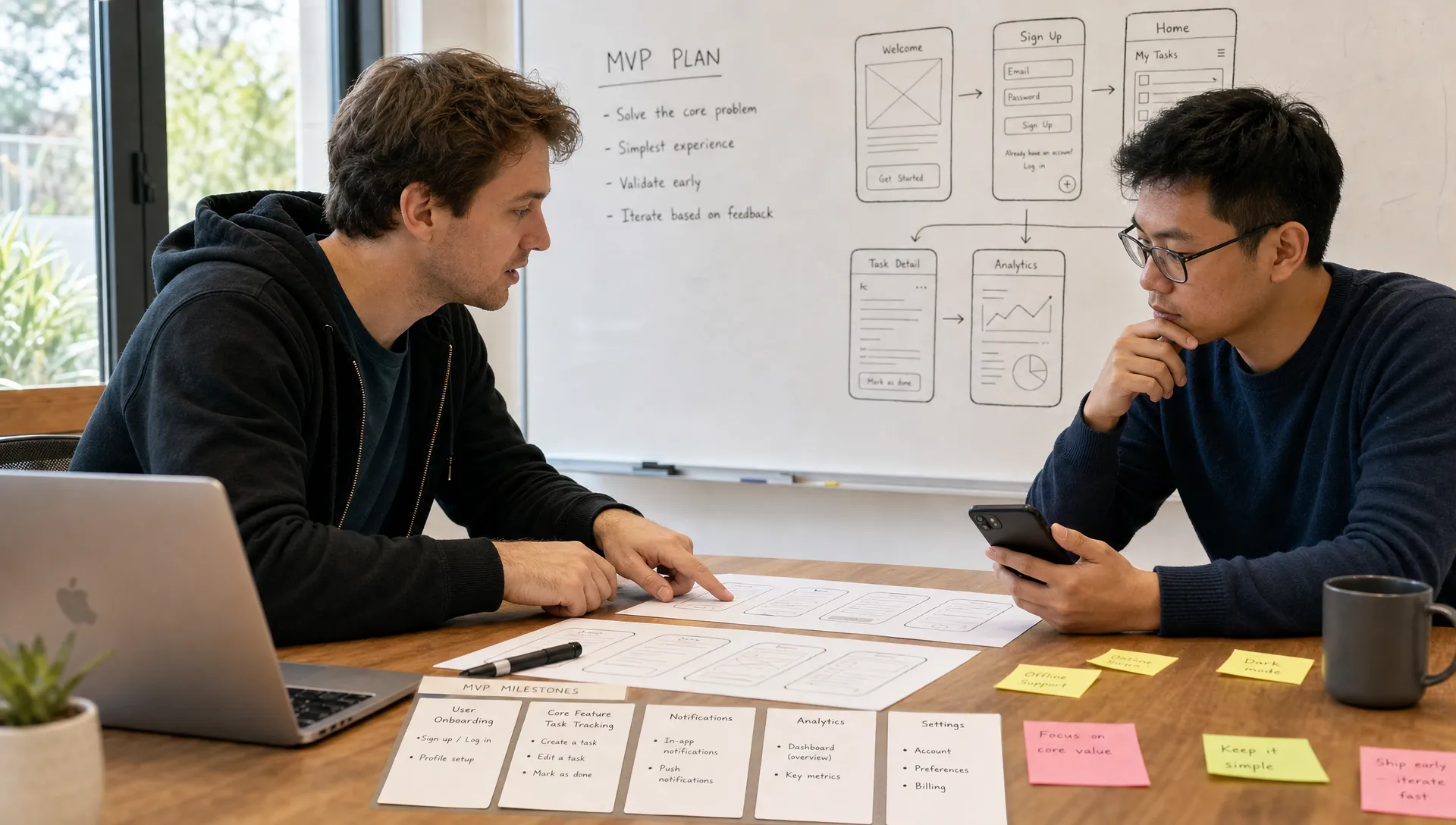
For many MVPs, the first milestone should not be a full build. It should create alignment. Depending on the project, that might include user flows, wireframes, technical architecture, data models or a clickable prototype.
This is especially valuable for non-technical founders because it turns abstract ideas into something you can review. You can catch misunderstandings before code is written. You can also make better decisions about which features belong in version one.
For a small local business, this milestone might map the current paper workflow into app screens. For a field service team, it might show how jobs move from scheduled to in progress to completed. For a healthcare app, it might identify what data is collected, who can access it and where compliance review is needed.
A developer who wants to jump straight into coding may still be capable, but skipping alignment increases the risk of rework.
Balance speed with maintainability
Fast MVP delivery is valuable only if the app can survive real users. Speed should come from focus, experience and reusable patterns, not from ignoring architecture, testing or security.
Clean code matters because your first app is rarely your last version. If users respond well, you will want to add features, fix onboarding, improve performance and maybe bring on additional developers. A messy codebase slows all of that down.
Ask how the developer structures projects for handoff. Ask whether they use version control, how they document setup steps and how they separate frontend, backend and third-party services. You do not need a lecture in software architecture. You need confidence that another qualified developer could understand the project later.
This is one reason cross-platform development can be attractive for startups. A single shared codebase for iOS and Android can reduce duplicated effort, keep features consistent and help founders launch faster. It is not always the right answer for every app, but it is often a practical choice for MVPs that need to test demand quickly.
Plan for launch and after launch
The app is not finished when coding ends. App store submission, production setup, analytics, crash monitoring, onboarding checks and post-launch fixes all matter.
Ask who will handle Apple App Store and Google Play submission. Ask what you need to provide, such as developer accounts, privacy policy links, screenshots, app descriptions and test credentials. If the app uses payments, health data, location tracking or user-generated content, app store review may require extra care.
After launch, track whether users complete the main action you designed the app for. Do not judge success by downloads alone. For an MVP, the better questions are whether users activate, return, complete the core workflow and give feedback that supports the next build.
You should also agree on a maintenance plan. Mobile operating systems change, dependencies update and bugs appear when real users bring real devices. Even if you do not need ongoing feature development, you should know how support will work.
Ready to hire with fewer risks?
Hiring the right developer is less about finding the lowest quote and more about reducing uncertainty. Clear scope, strong communication, realistic milestones and clean ownership terms protect your budget before a single line of code is written.
If you are a founder or small business owner looking to build an iOS and Android MVP, I offer cross-platform mobile app development with a focus on clean code, user experience and rapid 4-6 week MVP delivery. You can book a consultation with me to discuss your app idea, scope the first version, and decide whether a focused MVP is the right next step.