
Choosing the right mobile app developer is one of the highest leverage decisions your startup will make. The wrong hire can leave you with missed deadlines, confusing architecture, and an app that is hard to improve after launch. The right developer helps you turn an idea into a focused MVP, learn from real users, and build a technical foundation you can grow from.
For startups, the goal is rarely to build the biggest possible app. It is to build the smallest useful product that proves a market, supports a core workflow, and gives you enough confidence to raise funding, acquire customers, or keep iterating. That means your developer should be more than someone who writes code. They should understand product tradeoffs, mobile UX, technical risk, and the speed required at an early stage.
Below is a practical framework for choosing a mobile app developer for your startup, including what to prepare, how to compare candidates, what questions to ask, and which red flags to avoid.
Start with the outcome, not the technology
Before you compare portfolios or ask about Flutter, React Native, Swift, or Kotlin, define what success looks like for your first version. Many startup founders approach developers with a long feature list. A better approach is to explain the problem, the target user, and the business milestone the app needs to support.
A clear MVP brief helps a developer give you better advice. It also protects you from vague estimates, unnecessary features, and technical decisions that do not match your stage.
| What to clarify | Why it matters | Example |
|---|---|---|
| Target user | Shapes UX, onboarding, and feature priority | College students preparing for exams |
| Core problem | Keeps the MVP focused | Users need faster study planning |
| Primary workflow | Defines the first build | Create plan, complete task, track progress |
| Platforms | Affects cost and technology choice | iOS first, Android soon after |
| Timeline | Forces prioritization | Launch test version in 4-6 weeks |
| Success metric | Shows whether the MVP worked | 40 percent of beta users return weekly |
If you cannot yet define every detail, that is fine. A strong developer should help you narrow the product, not punish you for being early. What matters is that they ask questions that lead toward clarity.
Choose the right hiring model for your stage
There are several ways to build a mobile app. The best option depends on your budget, timeline, technical complexity, and how much product support you need.
| Option | Best fit | Potential drawback |
|---|---|---|
| Freelance mobile app developer | Early MVPs, fast iteration, direct communication | Capacity depends on one person or a small network |
| App development agency | Larger scope, multiple roles, formal process | Higher cost and more overhead |
| In-house developer | Long-term product ownership | Slow and expensive to hire before validation |
| No-code or low-code tool | Simple prototypes and internal tools | May become limiting for custom mobile experiences |
For many early startups, a freelance mobile app developer is a strong fit because you get direct access to the person building the product. This can reduce communication layers and speed up decisions. However, you still need to evaluate them carefully. A solo developer should be able to explain their process, communicate tradeoffs, and build in a way that future developers can understand.
Look for product thinking, not just coding skill
Technical skill matters, but a startup app usually fails because of unclear scope, poor user experience, slow iteration, or weak prioritization. The developer you choose should be comfortable discussing product risk as well as implementation.
A strong startup-focused developer will push back when needed. If your first version includes social feeds, chat, payments, advanced analytics, AI, admin dashboards, and multi-role permissions, a good developer should help you separate must-haves from later features.
Look for signs such as:
- They ask who the user is and what action the app must make easier.
- They recommend a smaller MVP when your scope is too broad.
- They can explain platform tradeoffs in plain English.
- They care about onboarding, error states, loading states, and retention.
- They talk about maintainability, not only speed.
You do not need a developer who agrees with every idea. You need someone who can help you make better decisions under constraints.
Evaluate platform experience and technology choices
A startup founder does not need to become a mobile engineer, but you should understand the major platform options. The most common paths are native iOS and Android development, cross-platform development, or a hybrid approach.
Native development can offer deep platform integration and high performance, but building separately for iOS and Android can increase time and cost. Cross-platform development can be faster for many MVPs because much of the codebase can be shared across platforms. The right choice depends on your app’s features, performance needs, design expectations, and roadmap.
Ask the developer why they recommend a specific approach. A good answer should connect the technology to your business goal. For example, if your startup needs to test demand quickly on both iOS and Android, cross-platform development may be more practical. If your app depends heavily on platform-specific APIs, native development may make more sense.
For UX quality, it is also worth checking whether the developer understands the expectations of each platform. Apple’s Human Interface Guidelines and Google’s Android app quality guidelines are useful references because mobile users expect apps to feel natural on their device.
Review portfolios with a critical eye
A polished portfolio is useful, but do not stop at screenshots. Screenshots show visual output. They do not show whether the app was delivered on time, whether the code was maintainable, or whether the developer made good technical decisions.
When reviewing previous work, ask what the developer personally built. This is especially important if the project involved a team. You want to know whether they handled UI, backend integration, state management, app store release, performance optimization, or all of the above.
You can also look for proof that the developer can explain technical decisions clearly. Developers who publish detailed breakdowns or tutorials often reveal how they think through problems. For example, a hands-on article like this ESP32 and Flutter BLE app tutorial gives you a way to assess practical engineering communication beyond portfolio visuals.
Ask better interview questions
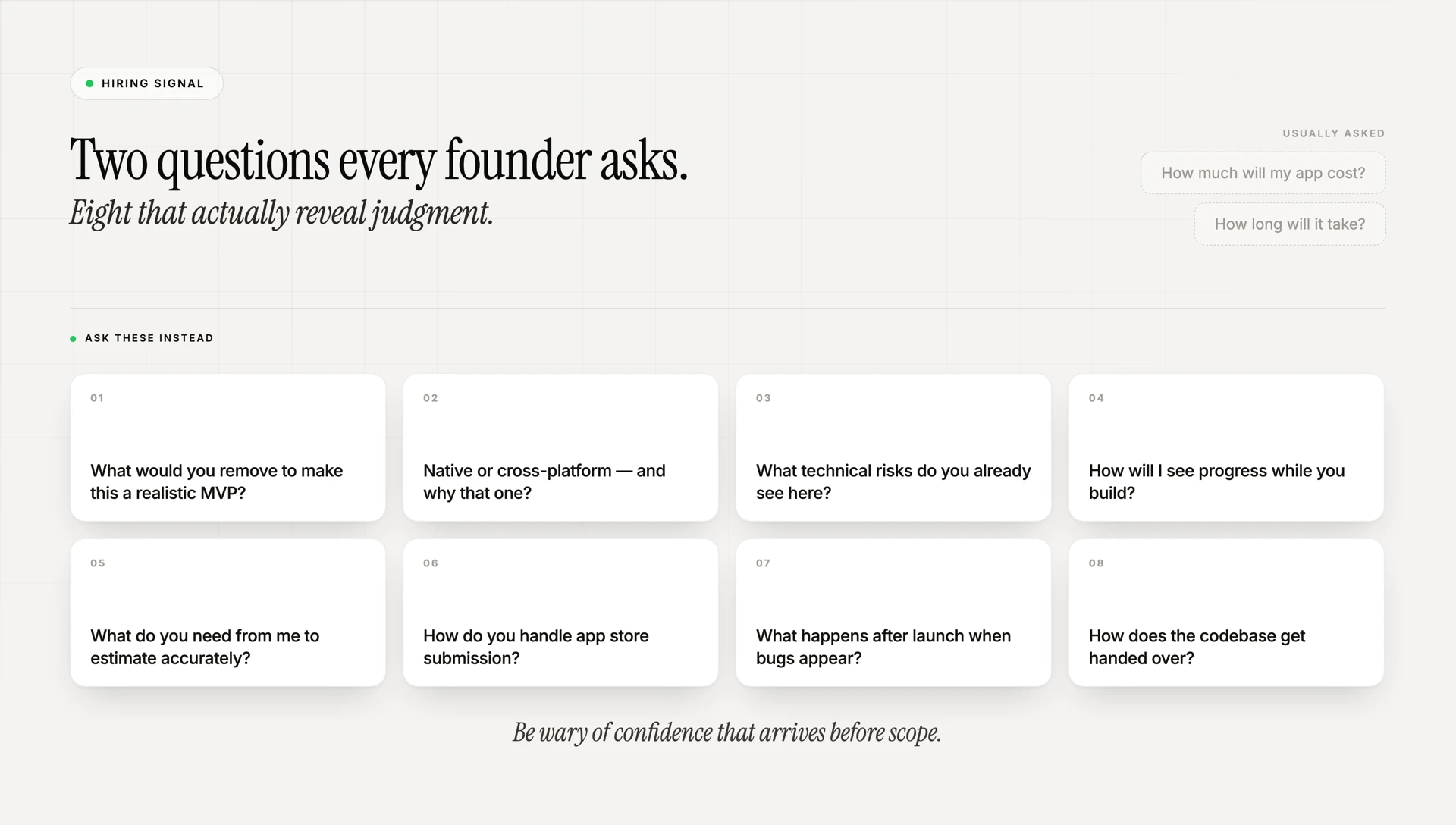
Many founders ask, “How much will my app cost?” or “How long will it take?” Those questions matter, but they are not enough. Better questions reveal how the developer thinks.
Use questions like these in your first call:
- What would you remove from this idea to make it a realistic MVP?
- Would you build this native or cross-platform, and why?
- What technical risks do you see in this product?
- How do you usually share progress during development?
- What do you need from me before you can estimate accurately?
- How do you handle app store submission and release preparation?
- What happens after launch if users find bugs or request changes?
- How will the codebase be handed over if we hire an internal team later?
The best answers are specific. Be cautious of candidates who answer everything with confidence before understanding the scope. Real startup work involves uncertainty, and experienced developers know how to identify unknowns early.
Check communication and process
A developer can be technically excellent and still be a poor fit if communication is weak. Startups move quickly, and unclear communication creates costly delays.
Ask how the developer manages milestones, feedback, and scope changes. You should know when you will see progress, how decisions will be documented, and what happens if a feature turns out to be harder than expected.
A simple MVP process often includes discovery, feature prioritization, wireframes or UI review, development milestones, testing, release preparation, and post-launch fixes. It does not need to be bureaucratic, but it should be clear.
Communication quality is visible before you hire. Notice whether the developer replies thoughtfully, asks relevant questions, explains tradeoffs, and summarizes next steps. If the sales conversation is confusing, the build process may be worse.
Understand what makes a 4-6 week MVP realistic
A 4-6 week MVP can be realistic when the scope is focused, the user flow is clear, and the developer is not trying to build a full product disguised as a first version. It is not realistic for every app idea.
A focused MVP might include authentication, a small number of core screens, one main workflow, basic data storage, essential API integrations, and a simple release path. A more complex product may need more time if it includes real-time messaging, payments, AI features, advanced permissions, offline sync, custom animations, complex admin tools, or heavy backend infrastructure.
The developer should help you identify what belongs in version one and what can wait. This is where startup experience matters. The goal is not to cut quality. The goal is to cut uncertainty by shipping the right first version.
| Scope factor | Easier MVP | More complex MVP |
|---|---|---|
| User roles | One user type | Multiple roles with permissions |
| Data flow | Simple create and view actions | Real-time collaboration or sync |
| Backend | Basic database and APIs | Complex business logic and integrations |
| Monetization | No payment in first version | Subscriptions, in-app purchases, or payouts |
| AI features | Simple API-based helper | Personalized models, memory, and evaluations |
| Launch | Private beta | Public launch with heavy compliance needs |
Prioritize code quality and ownership
For a startup, speed matters. But speed without code quality can create expensive problems later. A rushed app that cannot be maintained may slow down every future release.
Ask how the developer structures projects, handles errors, manages state, writes reusable components, and prepares the app for future changes. You do not need deeply technical answers, but the developer should be able to explain their standards clearly.
Ownership is just as important. Your startup should have access to the source code, project repository, app store accounts, design files if applicable, and documentation needed to continue development. Avoid arrangements where your business depends on someone else’s private account or undocumented setup.
For security-sensitive apps, ask whether the developer follows recognized mobile security practices. The OWASP Mobile Application Security Verification Standard is a respected reference for mobile security requirements, especially when apps handle user accounts, personal data, payments, or sensitive content.
Watch for red flags
Some warning signs are obvious, such as missed calls or vague pricing. Others are more subtle. Pay attention before signing anything.
Common red flags include:
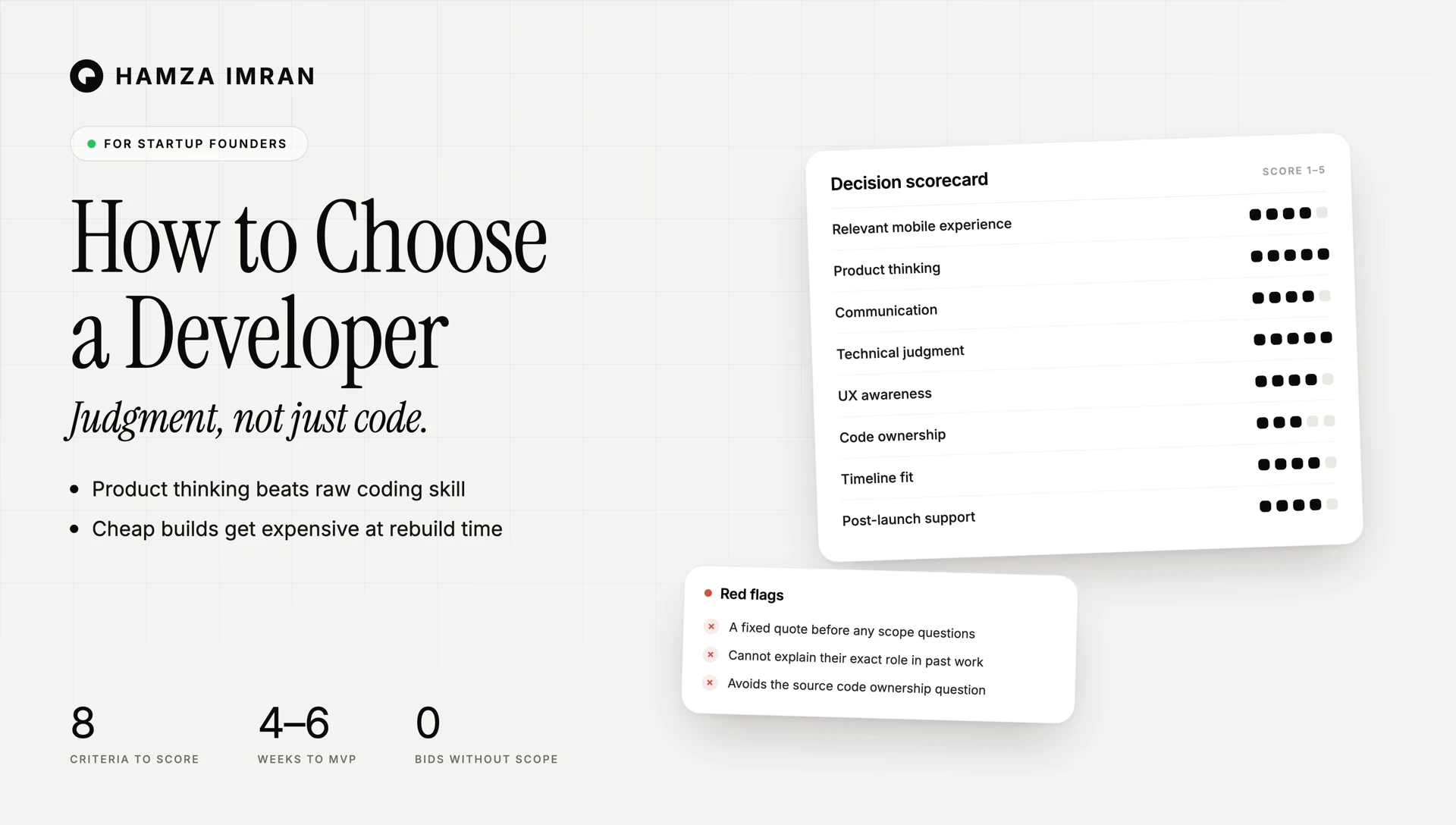
- The developer gives a fixed estimate without asking about scope.
- They promise a complex app in an unrealistic timeline.
- They cannot explain previous work or their exact role.
- They avoid discussing source code ownership.
- They dismiss testing, analytics, or release preparation.
- They push a technology without explaining why it fits your product.
- They do not ask about users, goals, or business constraints.
- They communicate poorly before the project starts.
A good developer does not need to be perfect, but they should be transparent. If something feels unclear during the hiring process, clarify it before development begins.
Use a simple decision scorecard
When comparing candidates, it is easy to be swayed by price or confidence. A scorecard helps you make a more objective decision.
| Criteria | What to look for | Score from 1 to 5 |
|---|---|---|
| Relevant mobile experience | Apps similar in complexity or platform needs | |
| Product thinking | Helps reduce scope and clarify MVP goals | |
| Communication | Clear, responsive, and structured | |
| Technical judgment | Explains platform and architecture tradeoffs | |
| UX awareness | Understands mobile flows and user expectations | |
| Code ownership | Provides clear handoff and repository access | |
| Timeline fit | Can meet your launch window realistically | |
| Post-launch support | Has a plan for fixes and iteration |
Do not automatically choose the cheapest option. Choose the developer who reduces risk. A slightly higher upfront cost can be worth it if it prevents rebuilds, delays, and poor user feedback.
Get the agreement right before work begins
A clear agreement protects both sides. It should define scope, milestones, payment structure, ownership, communication expectations, and what counts as a completed deliverable. It should also explain how changes are handled, because startup ideas often evolve during development.
At minimum, clarify who owns the source code, which accounts the app will be published under, what documentation will be delivered, and what support is included after launch. If your app involves confidential business logic or user data, discuss confidentiality and security expectations as well.
The agreement should not feel like a barrier. It should give everyone confidence about how the project will move from idea to launch.
Ready to choose the right developer?
If you are building a startup MVP, choose a developer who can balance speed, clean code, and product focus. Your first version should help you learn from users quickly without creating technical debt that slows you down later.
If you need a freelance mobile app developer for a cross-platform iOS and Android MVP, Hamza Imran is available for hire and focuses on clean code, strong user experience, and rapid MVP delivery in 4-6 weeks. You can also explore more articles and technical tutorials to get a feel for the engineering approach before booking a consultation.