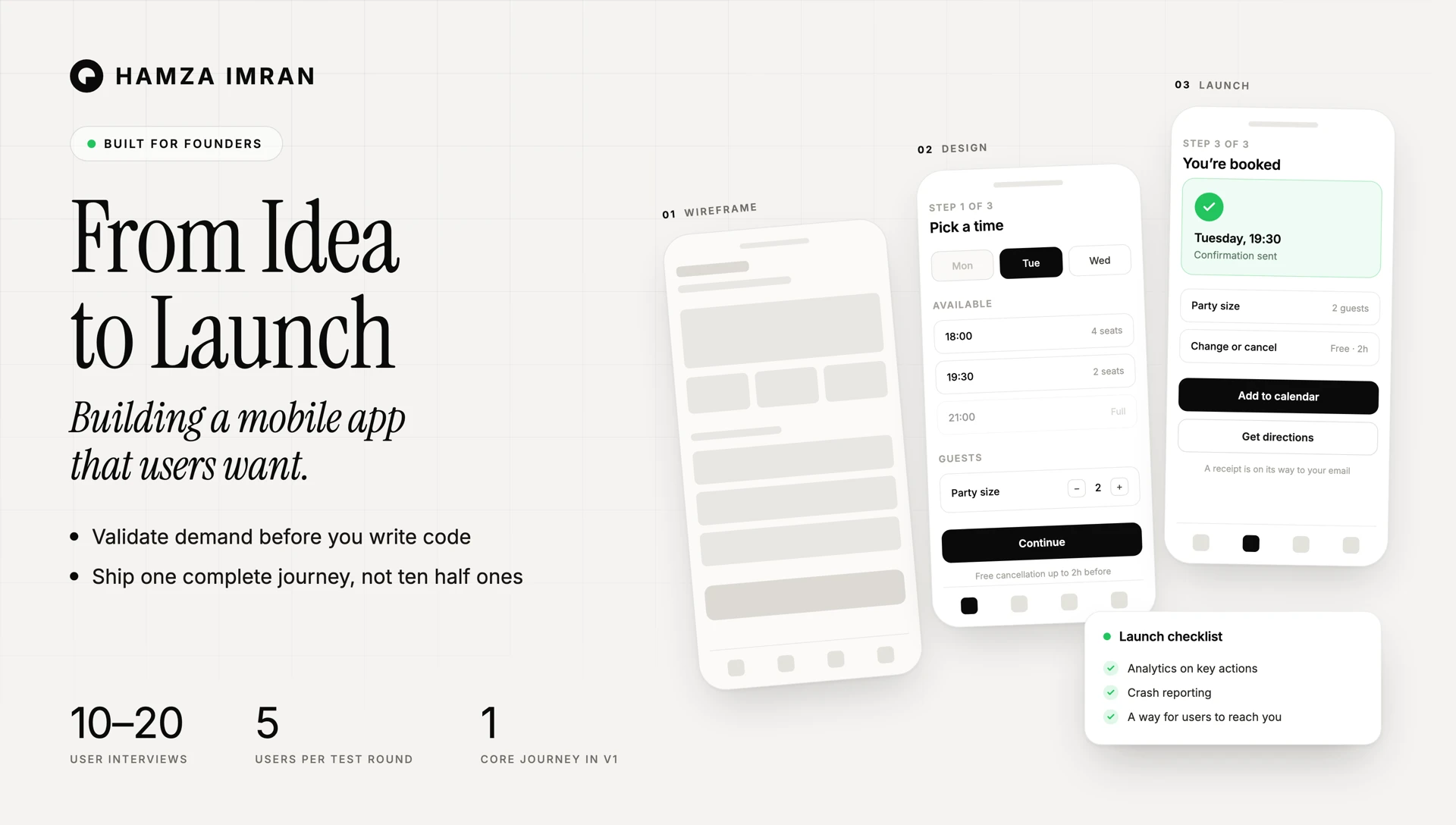

Most app ideas start with excitement: a feature you wish existed, a process your business wants to simplify, or a startup concept that feels obvious once you say it out loud. But users do not download an app because the idea is interesting. They download it because it solves a specific problem better than their current workaround.
That is the real challenge of building a mobile app. The hard part is not only writing code or getting into the App Store. The hard part is moving from a broad idea to a focused product that people understand, trust, and use more than once.
For small businesses, non-technical founders, and early-stage startups, this means treating the app as a product experiment before treating it as a full platform. You want to validate the need, define a practical MVP, build the right first version, and launch with a feedback loop that helps you improve.
Start with the user problem, not the feature list
A common mistake is describing an app by what it will contain: profiles, chat, bookings, payments, reminders, dashboards, maps, rewards, and admin controls. Features matter, but they are not the starting point. The starting point is the problem your user already has.
A strong app idea answers four questions clearly: who is the user, what are they trying to do, what blocks them today, and why would a mobile app be the best way to help?
For example, a local fitness studio might think it needs an app with workouts, class schedules, payments, push notifications, and a social feed. But the actual user problem may be much narrower: members forget to book classes early, classes fill up, and staff spend too much time managing last-minute messages. That problem points to a different MVP than a broad fitness platform.
| Weak starting point | Stronger product framing | Why it helps |
|---|---|---|
| I want an app for my restaurant | Regular customers need a faster way to reorder favorites and collect loyalty rewards | Focuses the product on repeat orders and retention |
| I want a social app for students | Students need a low-friction way to find study partners before exams | Defines a clear moment of need |
| I want a marketplace app | Local service providers need qualified booking requests without constant back-and-forth | Connects the app to a business outcome |
| I want an AI app | Users need personalized guidance to complete a recurring task faster | Keeps AI tied to a useful job, not a novelty |
When you frame the product this way, every design and development decision becomes easier. If a feature does not help the target user complete the core job, it probably does not belong in version one.
Validate demand before you write code
Validation does not mean asking friends whether they like your idea. Most people are polite, and polite feedback can be expensive. Real validation comes from evidence that your target users have the problem, care enough to change behavior, and understand the solution you are proposing.
Before building a mobile app, talk to the people who would actually use it. Ask about their current habits, not just their opinions. A founder building a study app should ask how students currently prepare for exams, what tools they already use, where they lose time, and what they tried before. A local business owner building a booking app should observe how customers book today, where staff lose time, and what causes no-shows or missed revenue.
Useful validation methods include:
-
Interviewing 10 to 20 target users about their current workflow, frustrations, and workarounds.
-
Creating a simple landing page that explains the value proposition and measures signups or inquiries.
-
Testing a clickable prototype before writing production code.
-
Running a manual concierge version of the service to see if people actually use it.
-
Asking users to commit in some way, such as joining a waitlist, booking a demo, or paying for an early offer.
Usability testing can also be valuable earlier than many founders expect. The Nielsen Norman Group has long argued that small rounds of testing with around five users can uncover many usability issues, especially when repeated across design iterations. The lesson is not that five users prove your business will work. The lesson is that early user feedback beats internal guessing.
Validation should leave you with clearer language. If users describe the problem in the same words you use on your landing page, app store listing, and onboarding screens, you are much closer to product-market clarity.
Shape the MVP around one valuable journey
An MVP is not a cheap or unfinished version of your dream product. It is the smallest complete version that helps a user achieve one meaningful outcome.
The word complete is important. A booking app MVP does not need advanced loyalty tiers, referral campaigns, and staff analytics. But it does need a user to find availability, book successfully, receive confirmation, and know what to do if something changes. A study companion MVP does not need every possible subject or social feature. But it does need to help a student get useful study support in a way that feels reliable.
A practical MVP should include enough value for users to judge the product honestly. If the first version is too thin, users are not rejecting your idea, they are rejecting an incomplete experience.
| MVP decision | Include in version one | Defer until later |
|---|---|---|
| User journey | One clear path from start to successful outcome | Multiple user types with separate workflows |
| Account setup | Only the fields required to deliver value | Long onboarding questionnaires |
| Payments | Basic checkout if payment is core to the business | Complex subscriptions, coupons, and referrals |
| Notifications | Critical reminders or confirmations | Frequent engagement campaigns |
| Admin tools | Simple controls needed to operate the product | Full reporting dashboards |
For many startups, a focused MVP is what makes a 4-6 week build realistic. The timeline depends on scope, design complexity, integrations, and review cycles, but the principle is consistent: speed comes from clarity. Every extra feature adds design decisions, development time, testing risk, and launch complexity.
Choose iOS, Android, or cross-platform based on the business goal
Platform choice should follow your audience and budget, not personal preference. If most of your users are on iPhones and you need the most polished iOS-specific experience, starting with iOS may make sense. If your market is Android-heavy, Android should not be an afterthought. If you need to reach both iOS and Android quickly with a shared product experience, cross-platform development can be a strong fit.
For many MVPs, cross-platform frameworks are attractive because they allow one codebase to support both major mobile platforms. That can reduce duplicated work and help founders test the market faster. Native development can still be the better option for apps with highly specialized platform requirements, complex device integrations, or performance needs that demand platform-specific implementation.
The best choice is the one that gets the right product into the hands of the right users with the least unnecessary risk. A good mobile developer should help you reason through that tradeoff instead of pushing a technology choice before understanding the product.
If you are still comparing hiring options, this guide on how to choose a mobile app developer for your startup explains what to look for beyond coding ability, including product thinking, communication, and MVP scope.
Turn the idea into a product blueprint
Once the problem, audience, and MVP are clear, the next step is to create a blueprint. This does not have to be a massive product requirements document. In fact, huge documents often hide uncertainty rather than resolve it. What you need is a shared plan that turns assumptions into buildable decisions.
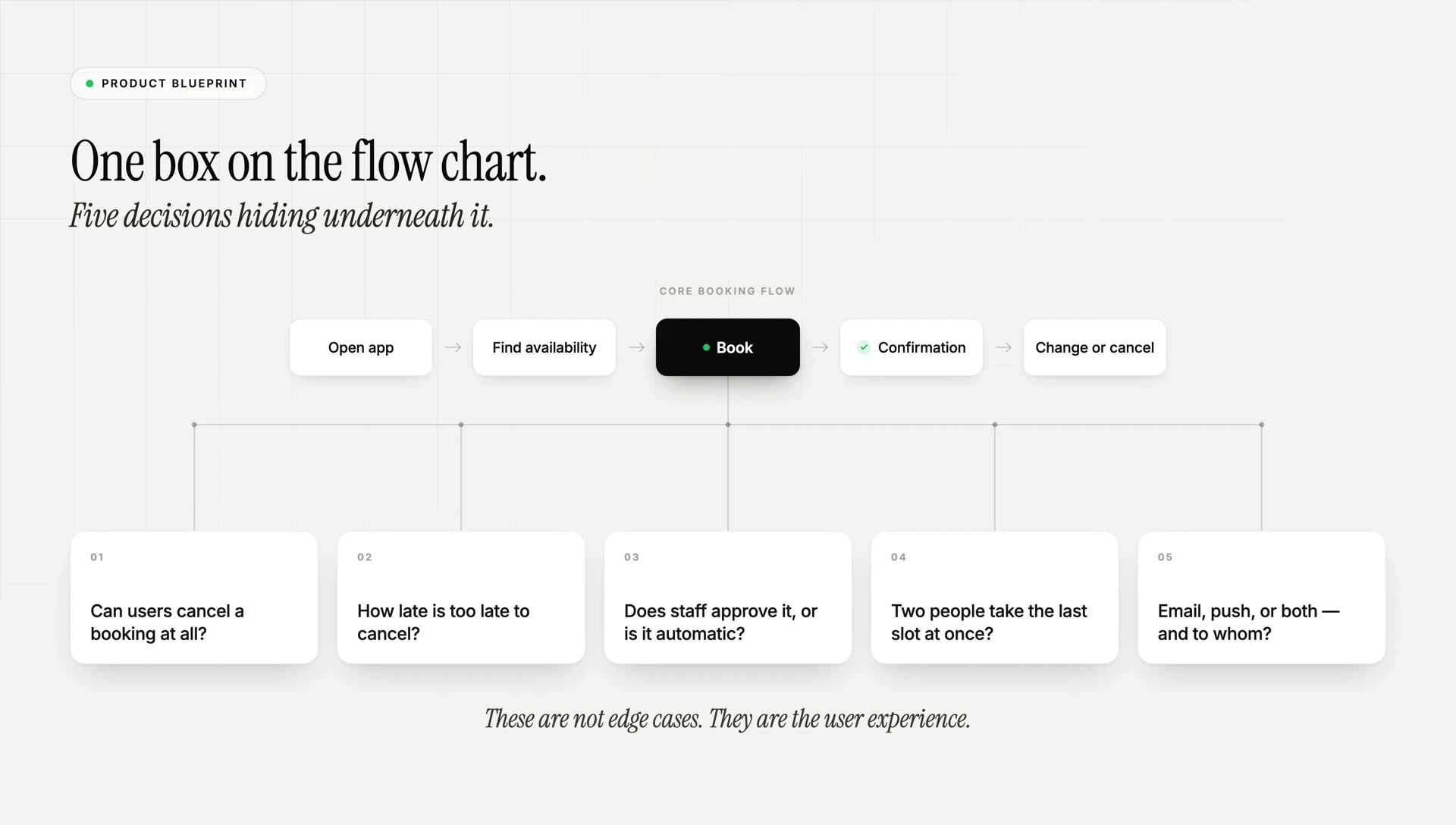
A good mobile app blueprint usually includes the core user flows, low or mid-fidelity wireframes, the main screens, required data, third-party integrations, and acceptance criteria for each feature. For non-technical founders, this planning stage is where a developer or product-minded technical partner can save significant time. Ambiguity that seems small in a meeting can become expensive once development starts.
For example, a simple booking feature raises many practical questions. Can users cancel? How late can they cancel? Does the business approve bookings manually or automatically? What happens if two people try to book the last slot at the same time? Should staff receive an email, push notification, or both? These details are not edge cases. They are part of the user experience.
Build with launch in mind from day one
A launch-ready app is not just a set of working screens. It needs to be understandable, stable, secure enough for its purpose, and easy to improve after users arrive.
This is where clean implementation matters. Early-stage apps often change quickly, so messy code can slow every future decision. A shortcut that saves one day during the MVP can cost several days later when you need to add onboarding, adjust pricing, fix a bug, or support a new user type. Clean code is not about perfection. It is about keeping the product flexible enough to learn.
Design quality matters too. Users compare your app to every other app on their phone, not only to direct competitors. Following established platform conventions helps the product feel familiar. Apple publishes Human Interface Guidelines for iOS experiences, while Google maintains Material Design guidance for Android and cross-platform product design. You do not need to copy every pattern, but ignoring user expectations creates friction.
During development, prioritize the parts of the experience that affect trust. Authentication should be clear. Loading states should be visible. Empty states should explain what to do next. Errors should be human-readable. If payments, personal data, or bookings are involved, users need confidence that the app is reliable.
Test the app with real people before launch
Testing should not wait until everything is finished. Founders should review working builds throughout development, and real users should test the core flow before public launch.
There are several types of testing to consider. Functional testing checks whether features work as expected. Usability testing checks whether people understand how to use the app. Performance testing checks whether the app feels responsive. Compatibility testing checks whether the app behaves properly across devices, screen sizes, and operating system versions.
For an MVP, the most important test is whether a target user can complete the core journey without explanation. If you have to sit beside them and narrate what to tap, the app is not intuitive enough yet. Watch where users hesitate, what they misunderstand, and what language they repeat. Those moments often reveal better product improvements than a long feature wishlist.
Beta testing can also reduce launch risk. A small group of early users can help uncover bugs, confusing flows, and missing expectations before the app is exposed to a wider audience. For local businesses, this might be loyal customers. For startups, it might be waitlist users or a small pilot group.
Launch before perfect, but not before usable
The goal is not to polish forever. The goal is to launch when the product is useful enough to create real learning.
A controlled launch is often better than a big public announcement. Start with a narrow audience, measure behavior, collect feedback, and fix the most important issues. This gives you room to improve without burning trust with a large group of potential users.
Before launch, make sure the essentials are in place:
-
App store name, subtitle, screenshots, and description that clearly communicate the main benefit.
-
Privacy policy and required disclosures for the data your app collects.
-
Analytics for the key actions users take in the app.
-
Crash reporting or a way to detect technical issues quickly.
-
A support channel so users can ask questions or report problems.
-
A feedback process for organizing bugs, requests, and product insights.
Your app store listing should not try to explain everything the app may become. It should make the first value proposition obvious. Users decide quickly, so the screenshots and first lines of copy should answer one question: why should someone install this now?
Measure what users do after launch
After launch, the most valuable feedback is behavior. Reviews and support messages matter, but analytics show whether users are reaching the outcome your MVP promised.
Do not track vanity metrics alone. Downloads can make a launch feel successful, but they do not prove the product is working. A smaller number of users who activate, return, and complete the core action is more meaningful than a large number of installs with no engagement.
| Metric | What it reveals | How to use it |
|---|---|---|
| Activation rate | Whether users reach the first meaningful outcome | Improve onboarding and simplify the first flow |
| Core action completion | Whether users can complete the main job | Fix usability issues or missing steps |
| Retention | Whether users find ongoing value | Strengthen reminders, value delivery, and habit loops |
| Drop-off points | Where users abandon the journey | Redesign confusing screens or reduce friction |
| Support requests | What users do not understand | Improve copy, empty states, and help content |
The best post-launch improvements usually come from combining data with direct conversations. If analytics show that users abandon the app during setup, interviews can reveal why. Maybe onboarding asks for too much information. Maybe users do not understand the benefit yet. Maybe they need to see value before creating an account.
This is why building a mobile app should be seen as a learning cycle. Idea, validation, MVP, launch, measurement, and iteration are connected. The first version is not the finish line. It is the first serious test.
Avoid the mistakes that make users leave
Many apps fail because they ask too much too soon. Long signup forms, forced account creation, unclear permissions, and crowded home screens can push users away before they experience value. If a feature is not essential to the first outcome, consider moving it later.
Another common mistake is building for every possible user. Early products need focus. A startup marketplace might eventually serve buyers, sellers, admins, and partners, but the MVP should prioritize the side of the market that proves the core transaction. A local business app might eventually include loyalty, referrals, content, and ecommerce, but the first version should support the behavior that matters most to revenue or retention.
Founders also underestimate maintenance. Operating systems change, dependencies update, users report bugs, and business needs evolve. A mobile app is not a one-time file you publish and forget. Plan for iteration, even if the first build is intentionally small.
Know when to bring in a mobile app developer
You do not need every detail solved before speaking with a developer. In fact, a good developer can help clarify scope, identify technical risks, and suggest a simpler path to launch. But you should have a clear problem, a target user, and a strong reason why mobile is the right channel.
It is time to bring in a developer when you can explain the core user journey, describe what success looks like, and commit to a focused MVP. If you are non-technical, look for someone who can translate your goals into practical product decisions, not just take a feature list and start coding.
Hamza Imran works with startups and clients on iOS and Android apps, including cross-platform MVPs, with a focus on clean code, fast delivery, and user experience. If you want help turning your concept into a buildable plan, you can work with a freelance mobile app developer who understands both product scope and mobile execution.
Turn your app idea into a focused launch plan
A successful app does not start with every feature you can imagine. It starts with a real user problem, a focused MVP, and a launch process designed to create learning.
If you are ready to move from idea to execution, schedule a 30-minute call at https://cal.com/hamzaimran/discovery-call to discuss your mobile app, clarify the MVP scope, and plan a practical path toward launch.