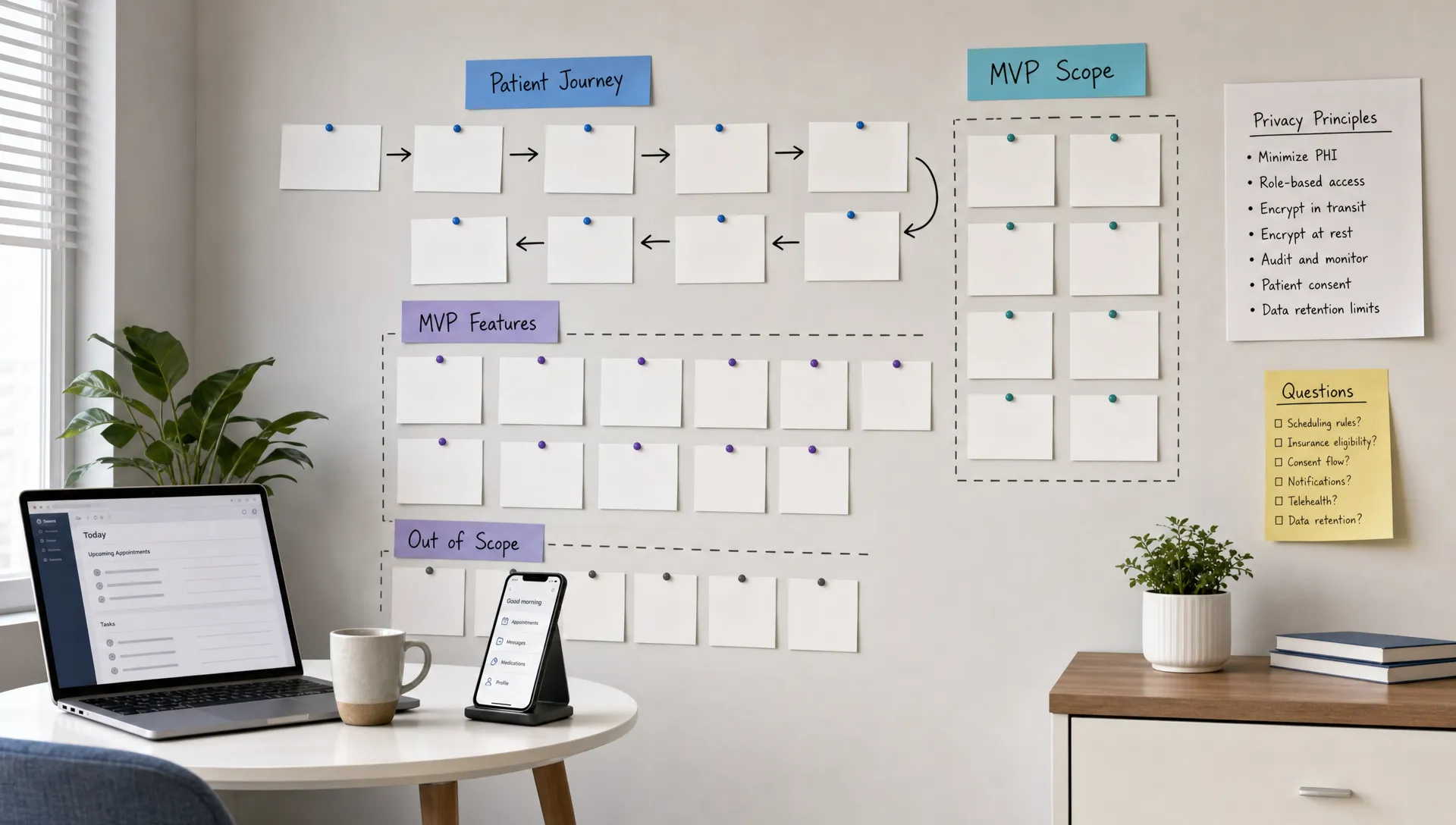

A HIPAA-compliant healthcare MVP is not a smaller version of a finished healthcare platform with compliance added later. It is a focused first release that proves one clinical, operational or patient-facing workflow while protecting protected health information from day one. For founders, clinics and health-tech teams, the goal is to validate demand quickly without creating security debt, vendor risk or privacy problems that become expensive to fix after launch.
This guide is not legal advice. HIPAA decisions should be reviewed with a qualified compliance professional or attorney. Still, you can make much better product and engineering choices when you understand how HIPAA affects scope, architecture, vendors and testing.
What makes a HIPAA-compliant healthcare MVP different?
HIPAA usually matters when your product handles protected health information, often shortened to PHI, for or with a covered entity such as a healthcare provider, health plan or healthcare clearinghouse. It can also apply when your company acts as a business associate for one of those organizations.
The HHS HIPAA Privacy Rule governs how PHI may be used and disclosed. The HHS Security Rule focuses on administrative, physical and technical safeguards for electronic PHI, also called ePHI. The Breach Notification Rule adds requirements if unsecured PHI is compromised.
A wellness app sold directly to consumers may not always fall under HIPAA, but it can still face privacy obligations under FTC rules, state laws or GDPR if it serves users in the EU. The practical lesson is simple: do not guess. Before writing production code, define who your customers are, what data you process and whether a covered entity relationship exists.
The safest way to build a HIPAA-compliant healthcare MVP is to treat compliance as a product constraint, not a paperwork task at the end.
How to build a HIPAA-compliant healthcare MVP in the right order
A healthcare MVP should start with risk reduction, not feature volume. The first release only needs enough functionality to prove the core workflow, onboard early users and collect validated feedback. If you need help narrowing that first release, this guide on how to scope an MVP app in six steps is a useful companion.
Step 1: Define the business outcome and user role
Start by writing one plain-language outcome. For example, a clinic may want patients to complete intake forms before appointments. A care coordination startup may want nurses to track follow-up tasks after discharge. A mental health provider may want clients to check in between sessions.
Then choose one primary user for the MVP. In healthcare software, trying to satisfy patients, providers, administrators and billing teams at the same time can multiply compliance and UX complexity. One clear user role makes it easier to define permissions, screens, notifications and audit requirements.
Step 2: Map every PHI touchpoint
Before building screens, map the complete data journey. Identify where PHI is created, viewed, edited, stored, transmitted, exported and deleted. Include less obvious places such as push notifications, analytics events, error logs, email alerts, file uploads, chat messages and customer support tools.
This map should answer practical questions. Does the app collect symptoms, medications, diagnoses, photos, insurance IDs or appointment notes? Will any data leave the app for email, SMS, a CRM, a help desk or an analytics platform? Who can access it internally?
Step 3: Reduce the first release to minimum necessary data
A HIPAA-compliant healthcare MVP should collect the least amount of PHI needed to deliver the tested workflow. This follows HIPAA’s minimum necessary principle and also makes the app easier to build, secure and explain to early customers.
For a patient intake MVP, you may not need document uploads, insurance card scanning, provider messaging and billing integration on day one. A secure form flow, role-based review screen and export process may be enough to validate whether clinics will use it.
| MVP decision | Safer first-release approach | Usually better later |
|---|---|---|
| Patient identity | Basic account creation with secure verification | Complex identity proofing and multiple login methods |
| Clinical data | Only fields needed for the core workflow | Broad medical history collection |
| Communication | Minimal in-app status updates | Full messaging, SMS and email automation |
| Integrations | Manual export or one critical integration | Multiple EHR, billing and CRM connections |
| Analytics | Product events without PHI | Detailed behavioral analytics tied to health data |
Core safeguards your healthcare MVP needs
HIPAA compliance is not achieved by using one encrypted database or signing one cloud contract. The MVP needs a combination of product, engineering and operational safeguards that match the risks in your workflow.
Administrative safeguards
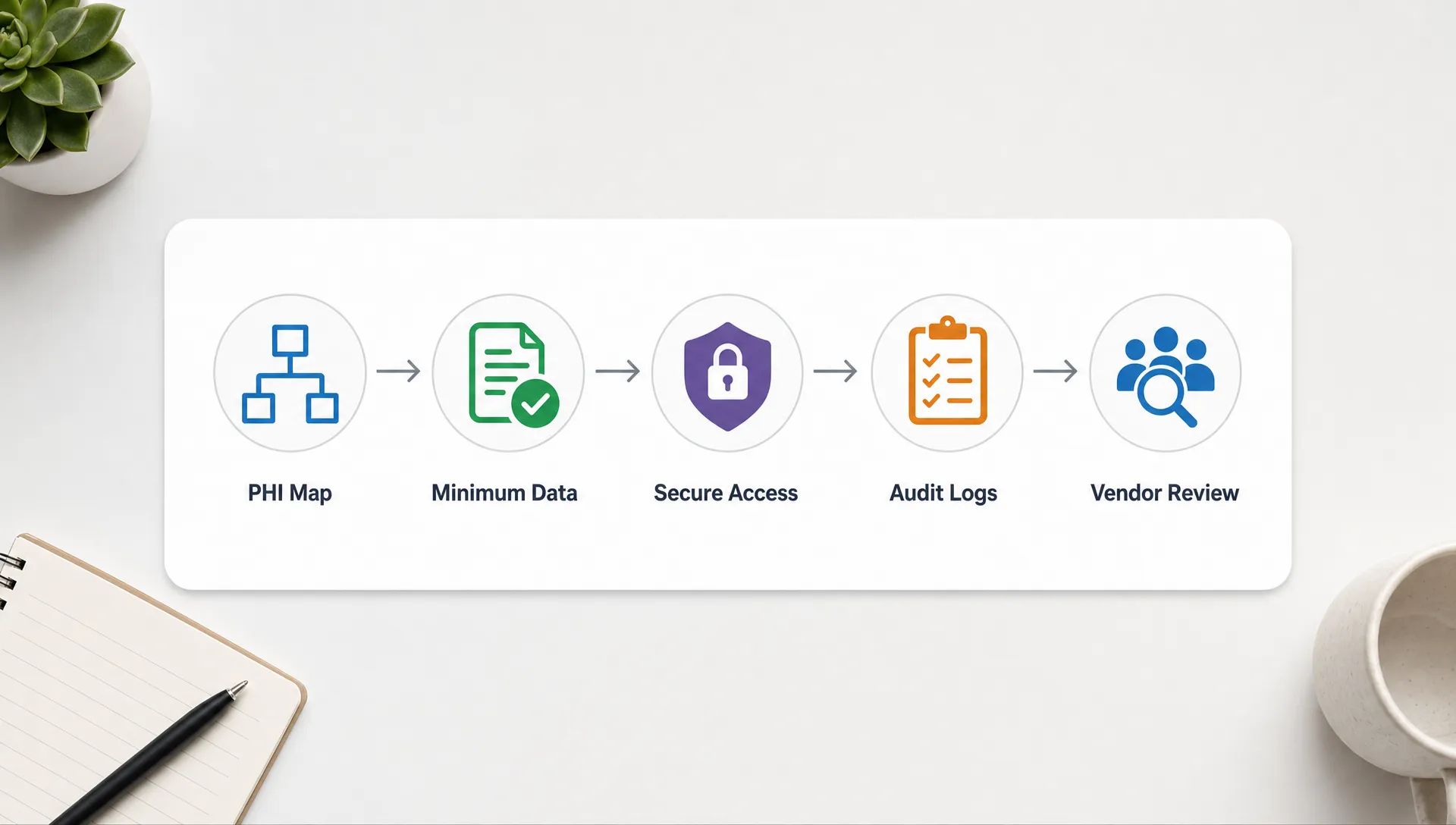
Administrative safeguards define who is responsible for security and how the organization manages risk. Even a small startup should document its security responsibilities, access approval process, incident response plan and vendor review approach.
The Security Rule also expects risk analysis and risk management. For an MVP, this does not need to be a hundred-page document, but it should identify likely threats, rank their impact and define how you reduce them before launch.
Technical safeguards
The technical layer protects ePHI inside the product. Common MVP-level controls include strong authentication, role-based access control, audit logs, encryption in transit, encryption at rest, secure password handling and automatic session expiration.
You should also avoid storing sensitive data on the device unless there is a clear need. If mobile storage is required, use platform-provided secure storage such as iOS Keychain or Android Keystore, not plain local files.
Product safeguards
A secure product still needs clear UX. Users should understand what data they are entering, who can see it and what happens after submission. This is especially important in healthcare, where trust can break quickly if the app feels vague.
When you plan a HIPAA-compliant healthcare MVP, treat microcopy, consent screens and permission prompts as part of the security experience. Privacy-friendly defaults reduce user confusion and support safer behavior.
Choosing the right technology stack and vendors
Technology choices matter because every external service that touches ePHI can create compliance obligations. A cloud provider may offer HIPAA-eligible services, but you still need to configure them correctly, sign the required business associate agreement and avoid sending PHI to unsupported services.
For a HIPAA-compliant healthcare MVP, the technology stack should be boring in the best way: stable, maintainable, well-documented and easy to secure. If the product needs iOS and Android quickly, cross-platform frameworks such as Flutter or React Native can be a good fit when the app does not require heavy native medical device integrations.
Vendor checks before you integrate anything
Third-party tools can quietly break your compliance posture. Analytics SDKs, crash reporting tools, chat widgets, email tools, push notification services and AI APIs must be reviewed before they receive any sensitive data.
Ask these questions before adding a vendor:
- Will this vendor receive, store or process PHI?
- Do they sign a business associate agreement if HIPAA applies?
- Can PHI be disabled, redacted or filtered before data is sent?
- Where is data stored and how is it encrypted?
- Who can access customer data inside the vendor’s organization?
If a vendor is not willing to sign a BAA and you cannot guarantee that PHI will never reach it, keep it out of the healthcare MVP. This is one reason lean scope matters. Fewer integrations mean fewer legal reviews, fewer security risks and fewer failure points.
Mobile-specific decisions
Mobile healthcare apps need extra care because phones are personal, portable and easy to lose. Avoid placing PHI inside push notification text. Use deep links that require authentication before showing sensitive content. Limit local caching and clear sensitive screens when the app is backgrounded if the use case requires it.
If speed is a major concern, a focused cross-platform build can help you move faster without duplicating every feature across two separate codebases. This article on how to develop a cross-platform mobile app faster explains how scope, reusable patterns and backend planning affect delivery time.
A realistic build plan for a healthcare MVP
A realistic HIPAA-compliant healthcare MVP timeline depends on the workflow, integrations, approval process and risk level. A simple intake, scheduling or care task app can move much faster than a product that connects to multiple EHR systems or supports complex clinical decision-making.
For many early-stage teams, the fastest path is not building more. It is proving the riskiest assumption with a narrow version of the product. If you have not yet tested whether clinics, providers or patients want the workflow, validate that first with interviews, prototypes or a landing page. This guide on how to validate your app idea before building an MVP can help reduce wasted engineering time.
| Phase | Main goal | Typical deliverables |
|---|---|---|
| Discovery | Confirm workflow, users and HIPAA exposure | User journey, PHI map, MVP scope, risk notes |
| UX and architecture | Design the safest simple version | Wireframes, data model, access rules, vendor list |
| Build | Implement the core workflow | Mobile app, backend, authentication, database, audit events |
| Hardening | Reduce security and privacy risk | Testing, logging review, permission checks, backup review |
| Pilot | Learn from real use | Limited rollout, feedback loop, bug fixes, support process |
If you are aiming for a 4 to 6 week build, keep the first version narrow. A secure patient check-in flow is realistic. A full telehealth, EHR-integrated, billing-enabled, AI-assisted clinical platform is not an MVP in that timeframe.
Testing before launch
Before you launch a HIPAA-compliant healthcare MVP, test both the user workflow and the ways data can leak. A normal QA checklist is not enough for healthcare software because sensitive data can appear in unexpected places.
Test account permissions carefully. A patient should not see another patient’s records. A front-desk user should not have clinician-level access unless the workflow requires it. An admin action should appear in audit logs with enough detail to investigate suspicious behavior.
Review logs, analytics and crash reports with sample data. If PHI appears in a tool that has not been approved for PHI, fix the instrumentation before launch. Test password reset, session timeout, file upload handling, deleted accounts and backup restoration.
You should also run a basic threat model. Consider lost devices, stolen passwords, misconfigured storage buckets, accidental email exposure, support staff over-access and third-party outages. The goal is not perfection. The goal is to find the most likely risks before your first real users do.
Common mistakes to avoid
The biggest mistake with a HIPAA-compliant healthcare MVP is assuming compliance can be bolted on after product-market fit. Retrofitting access controls, audit logs, encryption patterns and data minimization is slower than building them into the first architecture.
Another common mistake is collecting too much data because it might be useful someday. In healthcare, optional data is still a liability if it includes PHI. Every field should earn its place in the first release.
Founders also underestimate vendor sprawl. A modern app can send data to dozens of services if the team adds analytics, support chat, email automation, error monitoring and AI features without a review process. Keep the stack small until the compliance foundation is stable.
Finally, do not market the product as HIPAA compliant just because the hosting provider supports HIPAA workloads. Compliance depends on contracts, configuration, policies, access controls, staff behavior and the actual data flows in your product.
Build a safer healthcare MVP without overbuilding
A healthcare MVP has to move fast, but it cannot be careless with patient data. The right approach is to narrow the workflow, map PHI early, choose vendors carefully and implement the core safeguards before launch.
If you need an iOS and Android app developer for a secure, focused first release, I build cross-platform mobile apps and MVPs for startups and clients. You can book a consultation call and bring the product idea, compliance requirements and first workflow, then turn them into a practical mobile build plan without bloating the MVP.