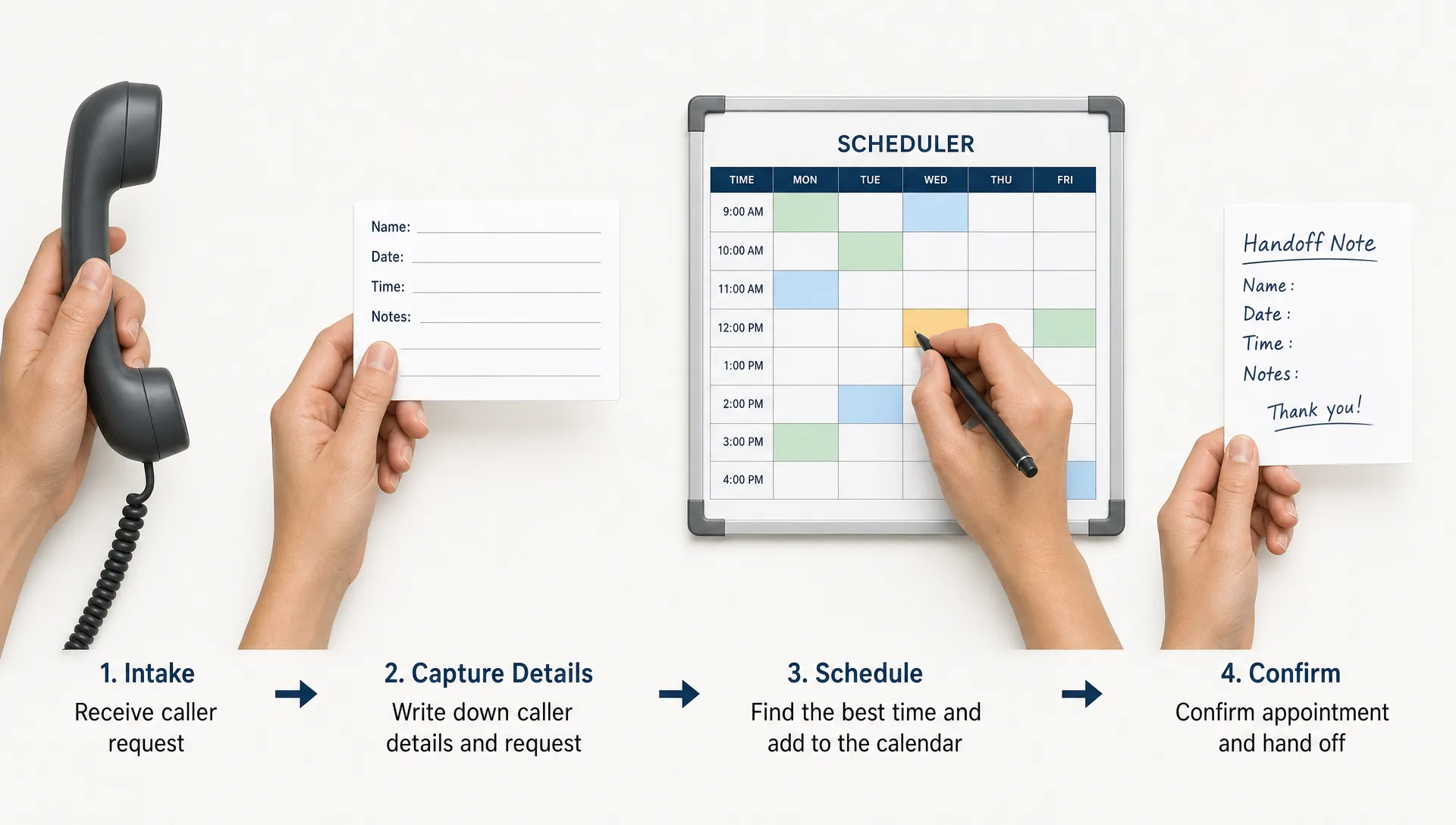

Service businesses do not lose appointments only because competitors are cheaper or closer. They often lose them because a customer calls after hours, reaches voicemail and books with the next provider who answers.
That is the practical gap AI voice agents are starting to fill. Instead of only taking a message, an AI voice agent can answer the phone, understand what the caller needs, check basic booking rules, reserve a time slot and send the details to your calendar or team.
For owners comparing AI voice agent appointment booking options, the goal is not to sound futuristic. The goal is simple: answer more calls, turn more qualified callers into booked jobs and reduce the back-and-forth that eats up your day.
What is an AI voice agent for appointment booking?
An AI voice agent is a phone-based assistant that can hold a spoken conversation with callers. For appointment booking, it combines speech recognition, a language model, business rules and calendar or CRM integrations.
A basic phone tree asks callers to press buttons. A live answering service takes messages or follows a script. An AI voice agent sits somewhere in between: it can ask follow-up questions, adapt to the caller’s answer and complete repetitive scheduling tasks without a human picking up every call.
For a service business, that usually means handling calls like:
- New appointment requests
- Reschedules and cancellations
- Basic service questions
- After-hours lead capture
- Appointment reminders and confirmations
- Urgent issue detection and escalation
If you are still deciding whether automated calls are a fit at all, it helps to understand the broader expectations around automated phone answering for small businesses before narrowing into appointment booking.
How the appointment booking workflow works
A good AI voice agent is not just a chatbot connected to a phone number. It needs a clear workflow that matches how your business actually books work. A plumbing company, dental office, cleaning service and mobile mechanic may all book appointments, but their rules are different.
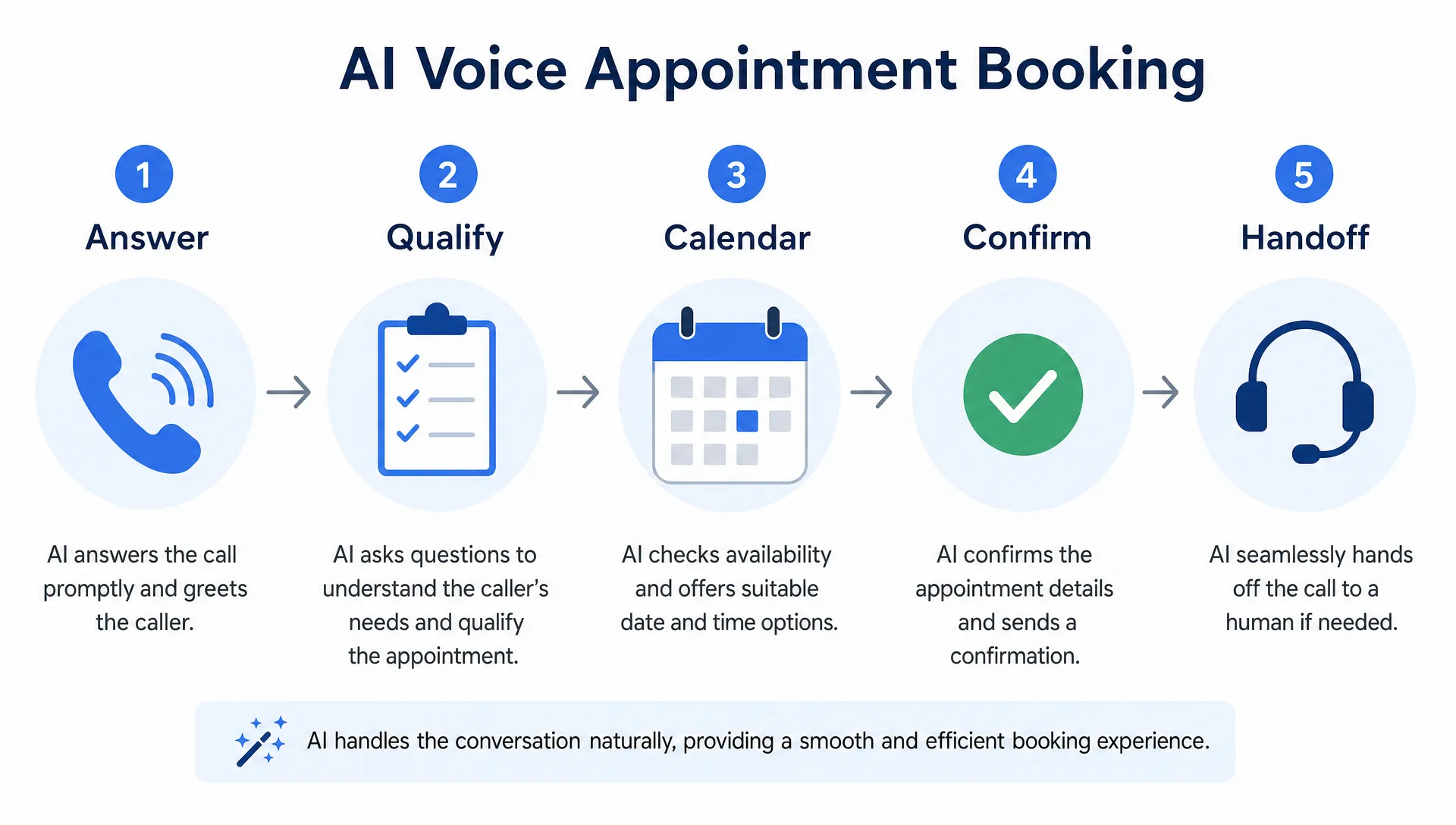
The agent answers and identifies the caller’s intent
The first job is to answer quickly and determine why the person called. The agent might ask whether the caller wants to book a new appointment, change an existing appointment, ask about pricing or speak to a person.
This matters because appointment booking should not be forced when the caller needs something else. If someone says there is flooding in a basement, a plumbing business may want immediate escalation. If someone asks for insurance details at a clinic, the agent may need to collect basic information and route the call to staff.
Intent detection should be simple, not overcomplicated. The agent only needs to classify enough to choose the right next step.
It collects the information needed to qualify the booking
Next, the agent gathers the details your team needs before putting anything on the calendar. This is where many businesses gain the most time back, because staff no longer need to ask the same intake questions all day.
Typical details include the caller’s name, phone number, email, service address, requested service, preferred time and any notes your technician or staff should know. For local service businesses, the agent can also check service area and availability before offering appointment times.
The right questions depend on the job. A cleaning company might ask for property size. A medspa might ask which treatment the caller wants. A field service company might ask whether the issue is urgent, whether equipment is accessible and whether the customer has used the business before.
It applies your booking rules
The biggest mistake with AI appointment booking is connecting an agent to a calendar too early. If your booking rules are vague, the agent will either overbook the team or route too many calls back to humans.
Before launch, define the rules that a trained receptionist already knows. These may include service duration, travel zones, staff skills, buffer time, minimum notice, emergency handling, deposit requirements and working hours.
For example, an HVAC company may allow maintenance calls online but require human approval for same-day emergency repairs. A healthcare practice may allow general consultation requests but avoid collecting sensitive clinical details through the voice agent unless the full system is designed for healthcare compliance.
It checks availability and offers appointment slots
Once the caller is qualified, the AI voice agent checks the connected scheduling system. This may be a calendar, CRM, field service platform, practice management system or custom booking backend.
A well-designed agent should offer a small number of relevant options rather than reading every available time. For example, it might say, “We have Tuesday morning between 9 and 11, or Wednesday afternoon between 2 and 4. Which works better?”
This keeps the conversation natural and reduces confusion. It also lets the business protect important operational rules, such as travel routing for technicians or buffer time between appointments.
It confirms the appointment and sends the details
After the caller chooses a slot, the agent repeats the key details: service type, time, location, contact number and any preparation instructions. Then it saves the appointment and can trigger a confirmation by SMS or email if that channel is configured and consent rules are followed.
This confirmation step is not cosmetic. Many booking errors happen because the caller and business remember different details. A clear verbal recap plus written confirmation gives both sides a shared record.
It logs the conversation for staff follow-up
The final step is internal handoff. The agent should create a clean record for your team, not just a raw transcript. Useful call summaries help staff see who called, what they booked, what they asked and whether anything needs attention.
For service businesses, that summary often matters as much as the appointment itself. A technician who sees “customer has a leaking pipe under kitchen sink, access through side door, dog on property” is better prepared than one who sees only a name and time.
| Booking stage | What the AI voice agent does | Why it matters |
|---|---|---|
| Answer | Picks up inbound calls quickly, including after hours | Reduces missed calls and voicemail delays |
| Qualify | Asks service-specific intake questions | Prevents incomplete or low-quality bookings |
| Schedule | Checks availability and follows booking rules | Avoids double bookings and bad time slots |
| Confirm | Repeats details and triggers SMS or email when configured | Reduces confusion and no-shows |
| Handoff | Sends summary, transcript or task to the team | Keeps humans informed for edge cases |
Where AI appointment booking fits best
AI voice agents work best when the appointment flow is repeatable. They are less useful when every call requires deep expert judgment or negotiation.
Good use cases include home services, salons, spas, clinics with controlled intake flows, cleaning companies, auto services, tutors, fitness studios and inspection businesses. In these environments, many calls follow predictable patterns: availability, price range, location, service type and preferred time.
They are also useful when your business has predictable call spikes. A roofer may get flooded with calls after a storm. A clinic may get many appointment requests on Monday morning. A fitness studio may see call volume rise around New Year. In each case, AI can capture leads before they go cold.
The strongest fit is usually a business where missed calls have a clear cost. If one booked job is worth hundreds of dollars, recovering even a few missed calls per month can justify testing automation.
What makes AI booking difficult in real businesses?
Appointment booking sounds simple until you map the real workflow. Customers ramble. They ask pricing questions before committing. They change their mind mid-call. They give partial addresses. They call from a noisy job site. They ask for “sometime next week” rather than a specific slot.
This is why a reliable AI voice agent needs more than a generic script. It needs guardrails.
Guardrails tell the agent what it can do, what it cannot do and when to bring in a human. For example, the agent may book standard consultations but escalate complaints, emergency calls, refund requests, medical questions or pricing exceptions.
Good design also accounts for failure. If the caller is confused, if the calendar does not respond or if the agent is not confident it understood the request, it should not guess. It should collect contact details and create a human follow-up task.
Privacy, consent and compliance matter
AI voice agents deal with personal information. Even a basic booking call may include names, phone numbers, addresses and service notes. For healthcare, legal, finance and other regulated sectors, the stakes are higher.
If you operate in healthcare, the system should be designed around HIPAA obligations where applicable. The U.S. Department of Health and Human Services explains how covered entities and business associates must protect health information. In practice, that means you should be careful about where call recordings, transcripts and summaries are stored, who can access them and whether vendors will sign the right agreements.
For businesses serving customers in the EU or UK, GDPR-style principles such as lawful basis, data minimization and retention limits should guide the design. The European Commission’s data protection guidance is a useful starting point for understanding those responsibilities.
Consent also matters for follow-up messages. If the agent sends SMS reminders, marketing follow-ups or automated callbacks, your process should respect applicable phone and messaging rules. The FCC’s robocall and text guidance is a helpful reference in the United States.
A practical rule for small businesses: collect only what you need to complete the booking, store it only where the business can manage access and give callers a clear path to a human.
What systems should an AI voice agent connect to?
The value of an AI voice agent increases when it connects to the tools your team already uses. If it only takes a message, it may still help. If it can update the calendar, create a CRM lead and notify the right staff member, it becomes part of operations.
Common integrations include calendars, CRMs, call tracking tools, field service software, practice management systems, help desks and SMS or email platforms. Some businesses also connect payment links or deposit workflows, but that should be handled carefully with secure payment providers rather than asking callers to say sensitive card details out loud.
For a simple business, an off-the-shelf booking platform may be enough. For a business with custom routing, multiple staff roles, mobile field teams or a customer app, a custom build can make more sense. If you are planning your first automation and are not sure what type of developer you need, this guide on hiring a remote AI developer for your first automation explains how to scope the work without overbuilding.
How to roll out AI voice appointment booking safely
Start narrow. Pick one call type that is frequent, valuable and easy to define. New appointment requests after hours are often a good first workflow because they are measurable and do not require replacing your entire front desk.
Before launching, write down your booking rules in plain English. Include what the agent should ask, what it should never promise, how it should handle emergencies and when it should transfer or create a callback.
Then test with real call scenarios. Use examples from past calls if you have them. Test noisy callers, vague callers, angry callers, price shoppers and callers who change their mind. The goal is not perfection. The goal is to know where the system behaves well and where it needs a human fallback.
A phased rollout usually works best:
- Start with after-hours call capture or overflow calls
- Review transcripts and summaries daily during the pilot
- Adjust scripts, rules and escalation triggers
- Add calendar booking only after intake quality is reliable
- Expand to reminders, reschedules or outbound callbacks later
This approach keeps risk low and gives the business owner evidence before investing in deeper integrations.
Metrics to track after launch
Do not judge an AI voice agent by whether it sounds impressive. Judge it by whether it improves the booking workflow.
| Metric | What it tells you |
|---|---|
| Answer rate | Whether fewer calls are being missed |
| Qualified lead capture | Whether the agent collects enough useful information |
| Booking conversion rate | How many eligible callers become appointments |
| Handoff rate | How often calls still need human intervention |
| Reschedule and cancellation rate | Whether bookings are accurate and convenient |
| No-show rate | Whether confirmations and reminders are helping |
| Staff time saved | Whether the team spends less time on repetitive calls |
If the handoff rate is high, the workflow may be too broad or the script may be unclear. If bookings are increasing but no-shows rise too, your confirmation process may need work. If callers are captured but not booked, your calendar rules or availability may be the bottleneck.
Ready to explore AI appointment booking for your business?
AI voice agents are most useful when they solve a specific operational problem, such as missed calls, slow follow-up or repetitive scheduling. The best first step is to map your real workflow before choosing tools.
If you want help identifying where AI can save time without overcomplicating your business, I offer an AI Audit for startups and small businesses that focuses on practical automation opportunities. You can also book a consultation call to discuss custom mobile app and AI automation work for your business.