
Yes, you can build a SaaS MVP in 4 to 6 weeks, but only if the product is small enough to prove one clear business idea. The timeline is realistic for a focused first version, not for a polished platform with every role, integration, dashboard, automation and compliance workflow already built in.
For a non-technical founder, the useful question is not whether a developer can code quickly. It is whether the first version is scoped tightly enough to reach real users, collect feedback and support the next decision. A 4 to 6 week SaaS MVP should help you answer a business question like: will businesses pay to manage this workflow in software instead of using spreadsheets, paper forms, texts or disconnected tools?
The answer depends on scope, decision speed and how much of the product can be built from proven patterns instead of custom invention.
What a 4 to 6 week SaaS MVP actually means
A SaaS MVP is not a smaller version of the final company. It is the first usable product that lets a specific user complete a specific workflow and experience the core value of the idea.
For example, a field service SaaS MVP might let a small plumbing company create jobs, assign them to technicians, upload notes and see job status from a simple admin view. That is very different from building full payroll, route optimization, inventory management, customer portals, accounting integrations and advanced reporting in the same first release.
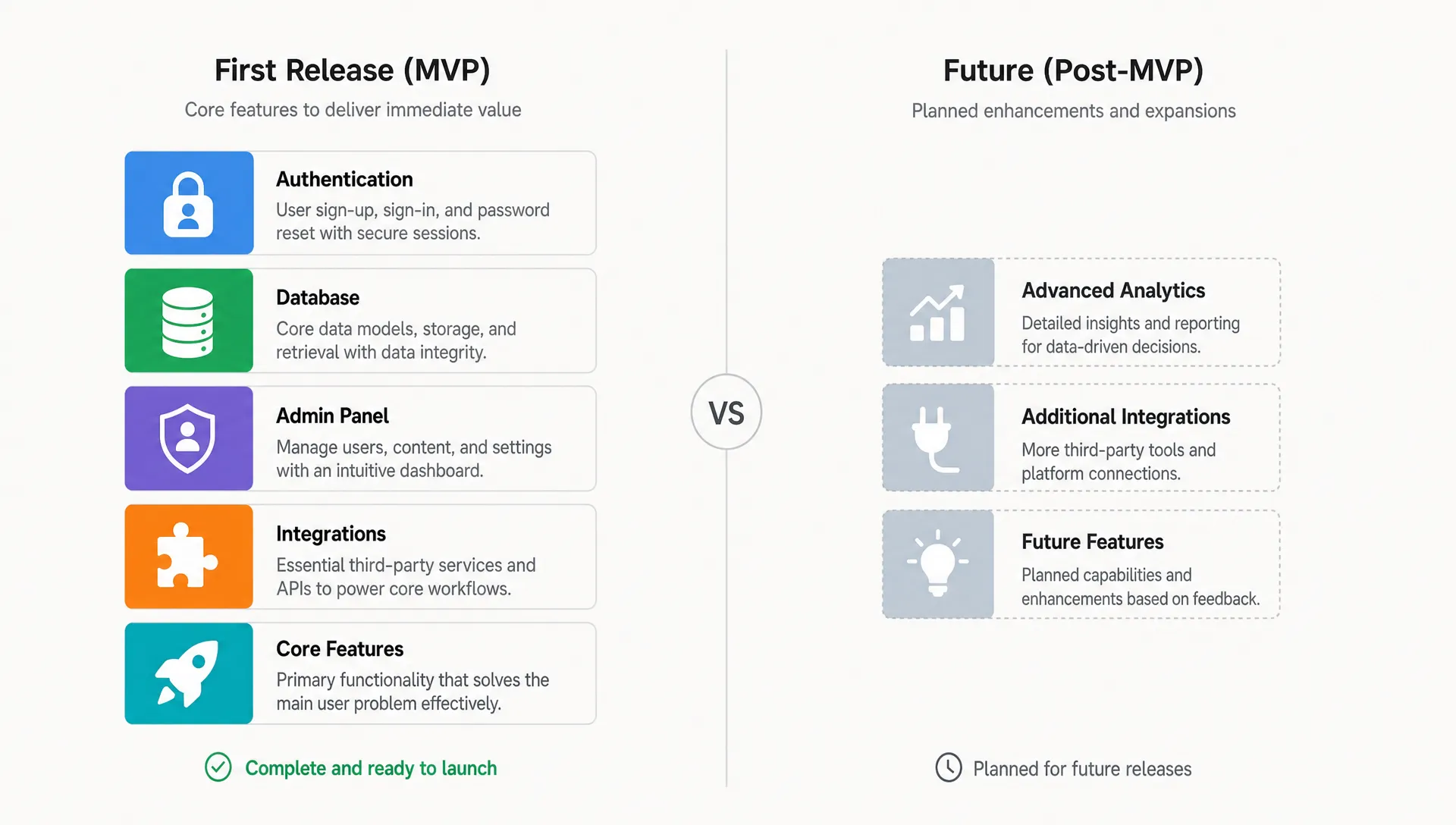
A realistic MVP should include just enough structure to be usable by early customers. That usually means authentication, core screens, a database, permissions, basic admin controls and a stable workflow. It does not need advanced settings, multi-language support, custom billing rules, complex analytics or every edge case from day one.
If you want a deeper scoping framework before you start development, this guide on how to scope an MVP app in 6 simple steps is a practical next step. The key idea is the same for SaaS: narrow the first version until one user can get one important job done.
When the 4 to 6 week timeline is realistic
The timeline works best when the MVP is built around one core workflow and one primary user type. It also helps when the founder can make decisions quickly, provide examples of the current manual process and avoid adding new ideas every few days.
Here is a simple reality check:
| SaaS idea | Realistic for 4 to 6 weeks? | Why |
|---|---|---|
| Appointment booking and intake for a local service business | Yes | The workflow is familiar and can be narrowed to booking, forms and admin review. |
| Job tracking for a small field service team | Yes | A focused version can cover job creation, status updates and notes. |
| Lead capture and follow-up dashboard for a niche business | Yes | The first version can focus on forms, contact records and simple reminders. |
| AI study companion with accounts and limited chat features | Possibly | It depends on whether you use existing AI services and keep the experience narrow. |
| Full CRM with email campaigns, pipelines, reporting and billing | Usually no | Too many modules compete for attention in the first release. |
| Healthcare platform with full HIPAA processes, audit trails and integrations | Usually no | Compliance, security review and workflows require more planning. |
| Two-sided marketplace with payments, reviews and dispute handling | Usually no | Supply, demand, trust and payments all add complexity. |
The founders who successfully build a SaaS MVP in 4-6 weeks usually reduce the product until the first release feels almost too simple. That is not a weakness. It is what makes learning possible.
A realistic 6-week build plan
The exact schedule depends on the product, but most fast MVP builds follow a rhythm like this:
| Phase | Main goal | Typical output |
|---|---|---|
| Before week 1 | Confirm the business goal | Scope document, user workflow, must-have features and launch criteria. |
| Week 1 | Design the experience | Wireframes, data model, screen flow and technical setup. |
| Week 2 | Build the foundation | Authentication, database, navigation and core app structure. |
| Week 3 | Build the main workflow | The primary user action, such as creating a job, booking a visit or submitting a form. |
| Week 4 | Build admin and supporting features | Admin review, status updates, notifications or simple reporting. |
| Week 5 | Test with real scenarios | Bug fixes, UX improvements, device testing and edge case cleanup. |
| Week 6 | Prepare for launch | Final polish, deployment, analytics setup and pilot user onboarding. |
If you skip planning, week 1 becomes discovery instead of development. That is one of the biggest reasons fast MVP timelines slip. A developer can move quickly when the target is clear, but they cannot safely guess your business rules, customer priorities or compliance requirements.
The scope rule: one user, one problem, one workflow
A SaaS MVP becomes slow when it tries to serve every possible customer from the start. A better approach is to write the first version around a single sentence:
This product helps [specific user] do [specific job] so they can achieve [specific result].
For a trades business, that might be: this product helps office managers assign service jobs to field technicians so they can stop tracking work through paper tickets and text messages.
For a healthcare admin workflow, it might be: this product helps clinic staff collect patient intake information before appointments so they can reduce phone calls and manual data entry.
For lead generation, it might be: this product helps a local business capture website leads, qualify them and follow up before they go cold.
Once that sentence is clear, every feature can be judged by whether it supports the first workflow. If it does not help the user complete the core job, it probably belongs in version two.
What can fit into the first release
A strong MVP is not featureless. It needs enough functionality to feel trustworthy and useful. The first release often includes:
- User login and account access.
- A core dashboard or home screen.
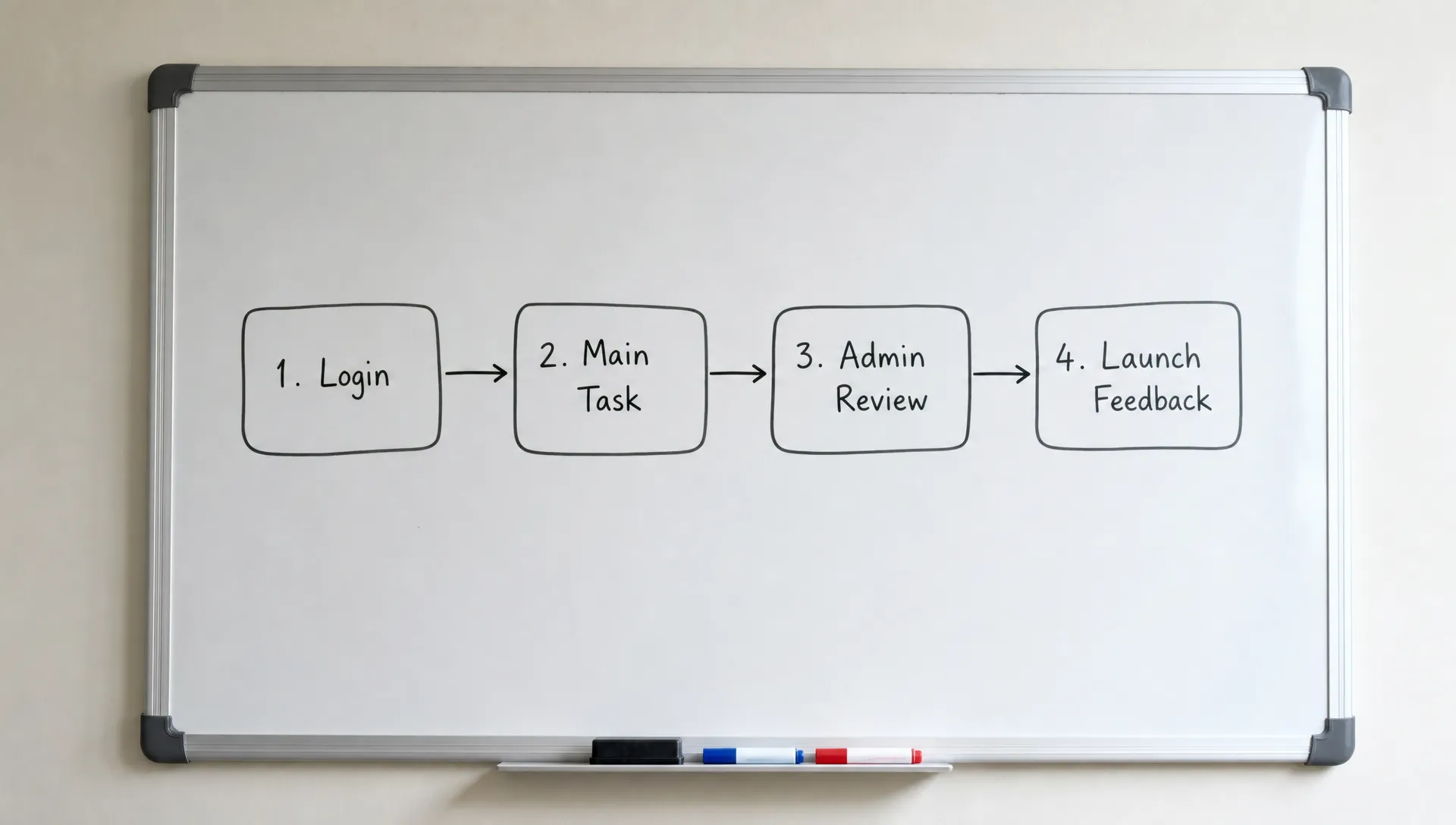
- The main workflow, such as creating a job, submitting a request, tracking a lead or managing a booking.
- Basic admin controls.
- Data storage for the records that matter most.
- Simple notifications or status updates when they are essential.
- Basic analytics or error tracking so the team can learn from real usage.
The important word is basic. A simple dashboard that shows the five most important records is often better than a complex reporting area nobody uses during the pilot. A clean workflow with fewer steps is usually more valuable than a large settings panel.
What usually makes a SaaS MVP take longer
Fast MVPs are rarely delayed by one huge technical surprise. More often, they slow down because of unclear decisions, expanding scope or hidden operational rules.
Custom roles can be one example. A product may start with admin and user access, then suddenly need owner, manager, staff, contractor, client and auditor permissions. Each new role affects screens, data access, testing and support.
Integrations are another common source of delay. Connecting to Stripe, Google Calendar, Twilio or an email provider may be manageable if the use case is simple. Syncing deeply with an old internal system, EHR, accounting platform or custom CRM can turn a small MVP into an integration project.
AI features also need careful scoping. Adding AI automation can be useful for summaries, suggestions, routing, support replies or lead qualification. But a vague requirement like make it smart is not buildable. A useful MVP defines where AI appears, what input it receives, what output it should produce and how the user can correct it.
Design can slow the build too. A polished user experience matters, especially if customers will pay for the product, but custom animations, complex branding systems and pixel-perfect experimentation are usually not the highest-value use of a short MVP timeline.
Should your SaaS MVP be web, mobile or both?
Many SaaS products start as web apps because admin dashboards, tables and forms are easier to use on a laptop. But some products should be mobile-first from day one.
If the user is in the field, at a gym, in a clinic, in a classroom or moving between customer sites, a mobile MVP can be the best way to prove the idea. Field service teams, fitness products, study tools, local business operations and on-the-go lead follow-up often benefit from iOS and Android access early.
A common approach is to build a focused mobile app for the primary user and a lightweight admin experience for the business owner. Cross-platform development can help reduce duplicate work when the same product needs to run on both iOS and Android. If mobile access is central to your product, this article on developing a cross-platform mobile app faster explains how reusable patterns and tighter scope can speed up delivery.
The decision should come from user behavior, not founder preference. If the user completes the core workflow at a desk, start web-first. If the user needs the product during real-world tasks, mobile may be the right MVP surface.
What about healthcare, HIPAA and GDPR?
Healthcare SaaS can be built quickly only when the first release is very carefully defined. A simple internal workflow, patient intake prototype or care coordination pilot may be possible in 4 to 6 weeks, but a production-grade healthcare platform with full compliance controls should not be rushed.
HIPAA in the United States is not just about adding a password. The HHS HIPAA Security Rule covers administrative, physical and technical safeguards for electronic protected health information. Depending on the product, you may need access controls, audit controls, transmission security, business associate agreements and documented policies.
GDPR also affects how products collect, process, store and delete personal data from people in the EU. The European Commission data protection overview is a useful starting point for understanding the regulation at a high level.
For a healthcare or privacy-sensitive MVP, the better approach is to decide what kind of pilot is safe. You may start with synthetic data, limited internal users or a workflow that avoids storing sensitive health information until the compliance plan is ready. A fast timeline should never mean careless handling of personal data.
How founders can prepare before hiring a developer
A 4 to 6 week MVP is a collaboration. The developer needs to write clean code and make smart technical decisions, but the founder needs to bring clarity about the business.
Before development starts, prepare the current manual workflow. If your business runs on paper forms, spreadsheets, WhatsApp messages or phone calls, gather real examples. These are more useful than a long feature wishlist because they show what the software must replace.
You should also define the first customer segment. A SaaS MVP for dentists is different from one for home care agencies, even if both involve scheduling and records. A lead generation tool for roofers is different from one for med spas, even if both capture inquiries.
Finally, choose one decision maker. Fast MVPs break down when every small choice needs approval from a group or when stakeholders keep changing the target. If you are still comparing development options, this guide on how to choose a mobile app developer for your startup can help you evaluate fit before you commit.
What a good 4 to 6 week MVP should prove
The first version should not try to prove everything. It should answer a small set of questions that matter to the business:
- Do users understand the product without heavy explanation?
- Can they complete the core workflow successfully?
- Does the product save time, reduce mistakes or create a result they value?
- Will users come back after the first session?
- Is the idea worth more investment after the pilot?
These questions are more useful than asking whether the MVP has every feature from the long-term roadmap. A small product that creates real customer pull is stronger than a broad product that nobody adopts.
Ready to test your SaaS idea faster?
If you have a focused SaaS idea and want to know whether it can be built in 4 to 6 weeks, the next step is to tighten the scope before writing code. I build cross-platform iOS and Android apps, MVPs for startups and clean mobile products designed for fast launch.
You can book a consultation call to review your idea, identify the smallest useful first version and decide whether a 4 to 6 week MVP timeline is realistic for your product.