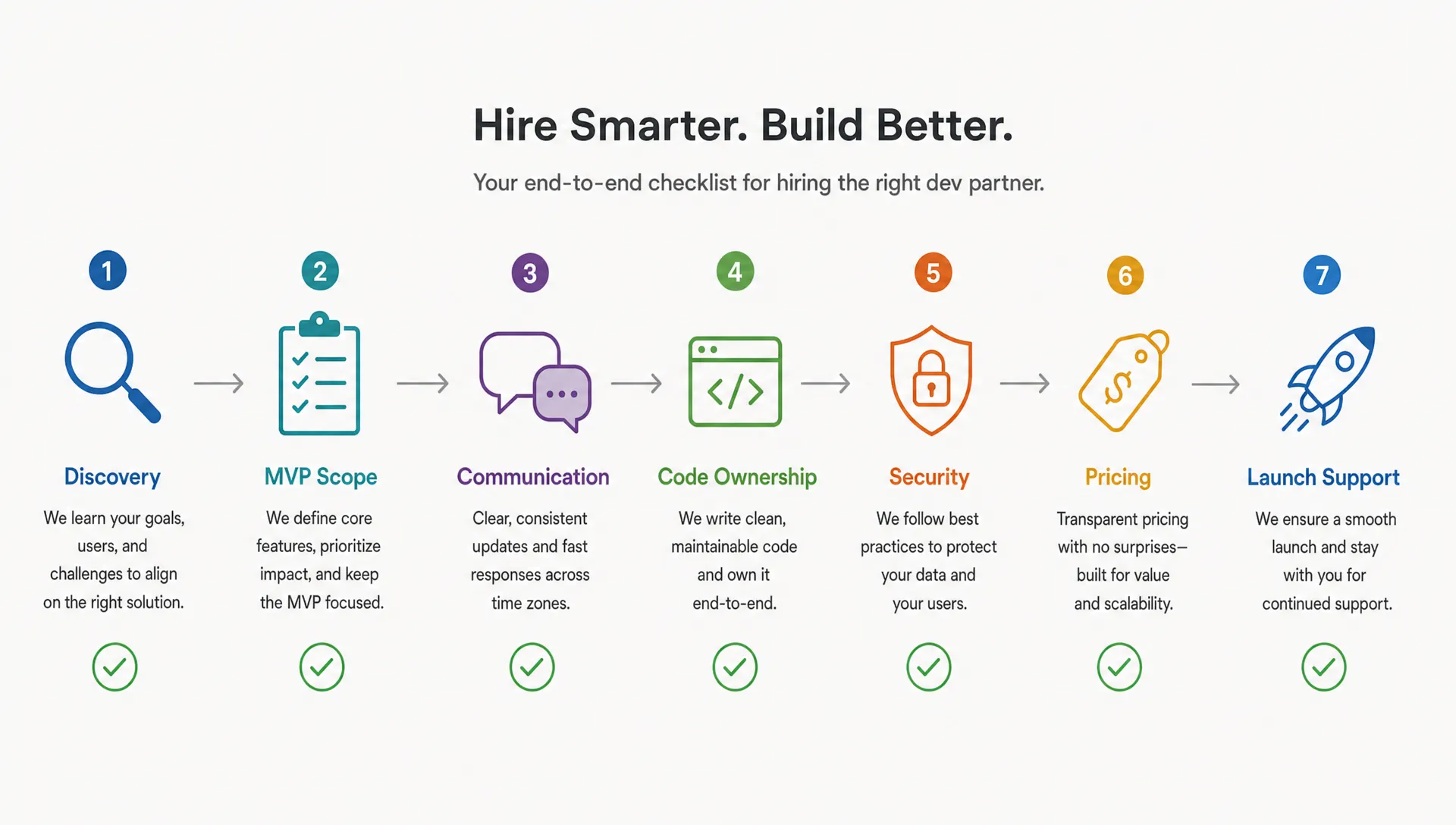

Hiring a mobile app developer in Pakistan can be a smart move for a founder or small business owner who needs solid engineering without the overhead of a large agency. Pakistan has a strong remote development market, many developers work comfortably with international clients and the cost structure can be more accessible than hiring locally in the US, UK or Europe.
Still, a good outcome is not automatic. The best experience comes when you know what a professional developer should bring to the project, what they will expect from you and where the boundaries of the engagement should be clear from day one.
If you are non-technical, this guide will help you understand what to expect before you hire, during development and after launch.
Expect a discovery conversation before anyone writes code
A reliable mobile app developer in Pakistan should not jump straight into screens and features. They should first ask about the business goal behind the app.
For a startup, that goal might be validating a new product idea with paying users. For a local business, it might be replacing paper forms, improving appointment booking, capturing leads or giving field staff a faster way to update job status. For a healthcare product, the conversation should also include privacy, data access and compliance expectations.
A strong discovery call usually covers:
- Who the app is for and what problem it solves
- The single most important action users need to complete
- Whether you need iOS, Android or both
- What data the app needs to collect, store or sync
- Which features are essential for launch and which can wait
- What success looks like after the first version goes live
If the developer keeps pulling the conversation back to outcomes, that is a good sign. It means they are thinking like a product builder, not just a task taker. If you need help narrowing the first version, it is worth learning how to scope your MVP before development starts so the project does not become too large too early.
Expect practical advice on MVP scope
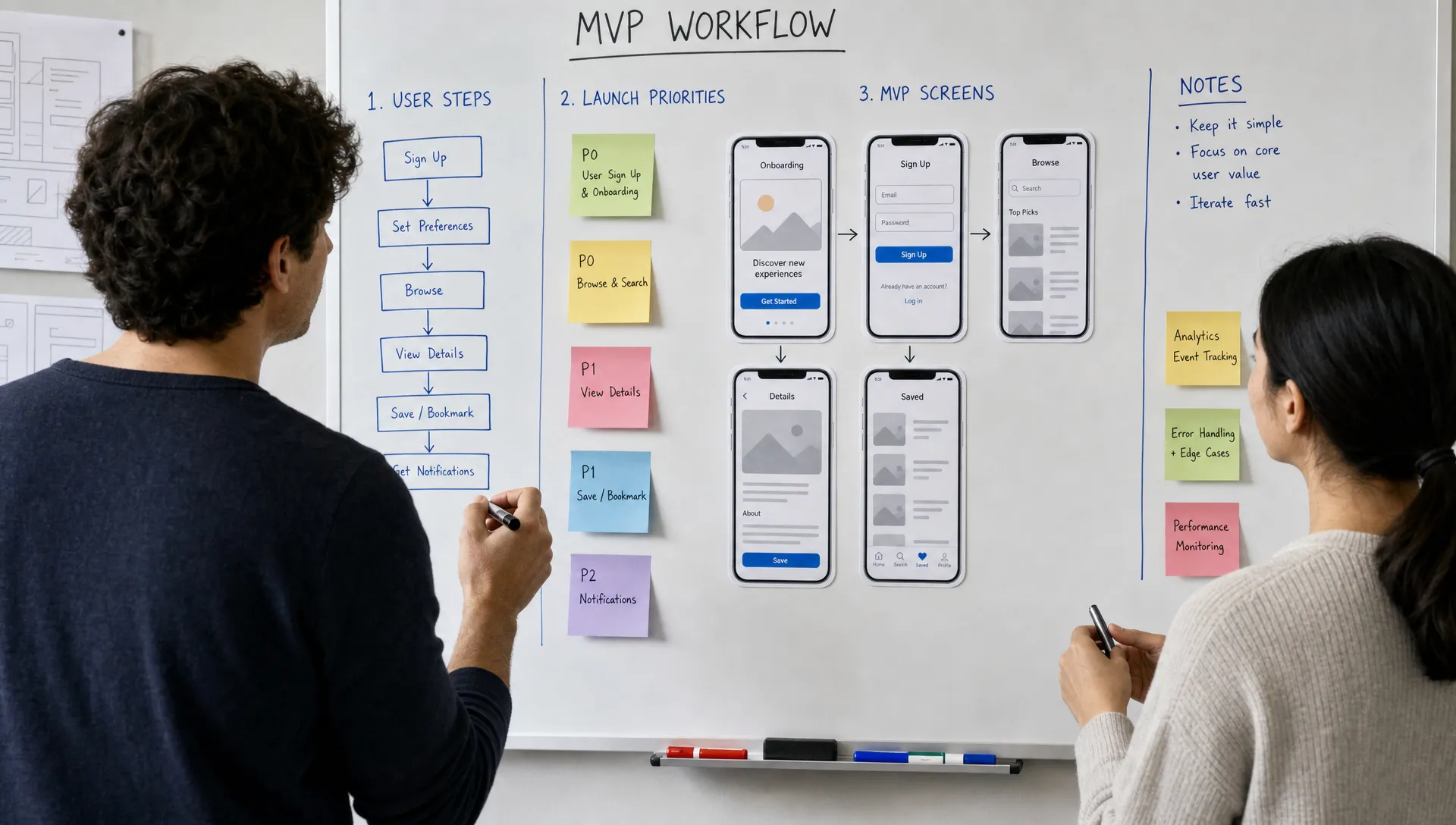
Many founders arrive with a long feature list. That is normal. A professional developer should help turn that list into a focused MVP instead of trying to build everything at once.
For a simple product, a 4 to 6 week MVP can be realistic when the scope is tight, the designs are clear and the backend requirements are not overly complex. A marketplace, healthcare platform, AI-heavy workflow or app with multiple user roles may need more time. The job of the developer is to explain those tradeoffs before the project starts.
A useful MVP conversation should separate features into three groups: what must exist for the app to work, what improves the experience and what can be tested later. This protects your budget and helps you launch before assumptions get too expensive.
| MVP planning area | What a good developer should clarify | Why it matters |
|---|---|---|
| Core user journey | The main path from opening the app to completing the key action | Prevents feature clutter |
| User roles | Whether the app serves customers, staff, admins or multiple groups | Affects screens, permissions and backend logic |
| Data flow | Where information is entered, stored, edited and exported | Reduces surprises in development |
| Launch platform | iOS, Android or cross-platform from one codebase | Impacts cost and timeline |
| Version 2 ideas | Features that are useful but not required for validation | Keeps the first build focused |
A developer who says yes to every feature without discussing tradeoffs may feel easy to work with at first, but that approach often creates delays later.
Expect clear communication across time zones
Working with a developer in Pakistan means you may be collaborating across several time zones. That can work very well when communication is structured.
You should expect agreement on response times, meeting frequency, preferred tools and the format of updates. For most startup and small business projects, one or two scheduled calls per week plus asynchronous updates is enough. Daily calls are not always necessary, but long silence is a problem.
Good communication usually includes short progress updates, screenshots or build previews, clear blockers and next steps. If a developer needs your feedback on a flow, design decision or third-party account, they should tell you exactly what is needed and by when.
As the client, you also have responsibilities. Delayed feedback, unclear priorities and changing requirements can slow the project down. A good remote workflow depends on both sides being organized.
Expect guidance on the right technology choice
Not every app needs custom native development for iOS and Android. For many MVPs, cross-platform development is the practical route because one codebase can support both platforms, reducing build time and keeping the first version easier to maintain.
A good developer should explain the tradeoffs in plain English. Native iOS or Android can make sense when the app depends heavily on platform-specific features, advanced performance or deep device integration. Cross-platform tools can be a better fit for booking apps, internal tools, lead generation apps, fitness apps, study apps, social MVPs and many business workflows.
The decision should be based on your users, budget and timeline, not on what sounds trendy. If you are comparing options, this guide on when Flutter is the right choice gives a practical breakdown for founders who need iOS and Android without building two separate apps.
Expect professional handling of code and ownership
Clean code is not just a developer preference. It affects whether your app can be improved, debugged and handed to another developer later.
Before the project begins, clarify who owns the code, where the repository will live and what happens at handover. A professional developer should be comfortable using version control, organizing the project clearly and explaining the structure at a high level. You do not need to understand every file, but you should not be locked out of your own product.
You should also discuss whether the developer will set up the project under your Apple Developer account, Google Play Console, cloud account or company repository. In many cases, it is better for the business owner to control core accounts from the start, then grant access to the developer.
| Code and ownership item | What to ask for |
|---|---|
| Repository access | Make sure the code is stored in an account you can access |
| Commit history | Ask that work is committed regularly, not delivered as a mystery zip file |
| Environment setup | Request basic instructions for running the project later |
| Third-party services | Keep key accounts under your business email when possible |
| Handover | Clarify what files, credentials and documentation are included |
This is especially important if you are building an MVP now but expect to raise funding, add a team or continue development after launch.
Expect UX input, not just programming
A mobile app can technically work and still frustrate users. For founders and small businesses, usability often matters more than having a long feature list.
A good mobile app developer should care about the flow of the product. They should notice if a form is too long, if onboarding asks for too much information, if buttons are unclear or if a field service worker will struggle to use the app outdoors with limited time. Great user experience is often built through small decisions.
For example, a trades business replacing paper job sheets may need large touch targets, offline-friendly thinking and simple status updates. A healthcare app may need careful language around consent, secure access and patient information. A lead generation app may need fast loading, clear calls to action and minimal friction.
The developer does not need to replace a full product designer unless that is part of the agreement. But they should be able to raise UX concerns when something will hurt adoption.
Expect serious questions about privacy and security
If your app collects personal information, payments, location data, health information or business records, privacy cannot be treated as an afterthought.
A responsible developer should ask what data is collected, who can access it, where it is stored and how users can control their information. For healthcare software, you may need HIPAA considerations in the US or GDPR considerations if you serve users in the EU or UK. A developer can help implement technical safeguards, but legal compliance also requires the right policies, contracts and operational practices.
For mobile security, the OWASP Mobile Top 10 is a useful reference because it highlights common mobile app risks such as insecure data storage, weak authentication and poor communication security.
At minimum, you should expect a discussion about secure authentication, data permissions, encrypted connections, access control and safe handling of API keys. If a developer dismisses security because the app is only an MVP, that is a red flag. MVP does not mean careless.
Expect transparent pricing, milestones and change control
Rates can vary widely depending on experience, complexity and whether you hire a freelancer, small team or agency. Rather than focusing only on the lowest price, look for clarity.
A professional estimate should explain what is included, what is not included, how revisions are handled and when payments are due. For a fixed-scope MVP, milestone-based payments often make sense. For an evolving product, a weekly or monthly engagement may be better.
You should also expect a clear process for changes. New ideas will come up during development. That is healthy, but every new feature can affect cost and timeline. A good developer will help you decide whether a change belongs in the current release or a future version.
| Contract area | What should be clear before work starts |
|---|---|
| Scope | Screens, features, integrations and supported platforms |
| Timeline | Expected delivery stages and review points |
| Payment | Deposit, milestones, final payment and accepted methods |
| Revisions | How many rounds are included and what counts as a new feature |
| Support | Whether bug fixes, launch help or post-launch improvements are included |
Cheap development becomes expensive when the scope is vague. Clear terms protect both sides.
Expect launch support, but define what launch means
Launching a mobile app involves more than finishing the code. You may need testing, app store preparation, privacy policy links, screenshots, build signing and review submissions.
Do not assume every developer includes full launch support by default. Ask whether they will help submit the app to the App Store and Google Play, prepare production builds, fix review issues and monitor early bugs. Apple and Google both have policies that can affect approval, especially for apps involving payments, user-generated content, health data or subscriptions.
For founders, the best launch plan starts before the final week. You should know who is writing the store description, who is creating screenshots, who owns the developer accounts and who will respond if the app is rejected or needs changes.
If you are still shaping the product and want a broader view of validation, build and release planning, this guide on building a mobile app that users want covers the full path from idea to launch.
What not to expect from a developer
A mobile app developer in Pakistan can be a strong technical partner, but you should not expect one person to automatically cover every business function unless you agreed to it.
Do not assume the developer will provide legal compliance documents, write your business plan, create a full brand identity, manage paid ads or guarantee app store approval. Some developers can help with parts of these areas, but they are separate responsibilities.
You should also avoid expecting unlimited revisions under a fixed quote. A professional developer should be flexible when reasonable improvements are needed, but major changes to user roles, backend logic or product direction are new scope.
The healthiest working relationship is direct: you bring business knowledge and fast feedback, the developer brings technical execution and product judgment.
Green flags when hiring in Pakistan
The strongest developers usually make the project feel clearer after the first conversation. They ask focused questions, explain tradeoffs simply and help you make decisions instead of overwhelming you with jargon.
Look for evidence of shipped work, not just design mockups. Ask what parts of past apps they personally built, how they handled bugs and what they would do differently now. If the developer has experience across different product types such as fitness, study, social or business apps, that can be useful because they have seen different user flows and technical patterns.
Strong green flags include realistic timelines, clear boundaries, clean communication, comfort with ownership questions and willingness to challenge unnecessary features. Red flags include vague pricing, no written scope, reluctance to share progress, pressure to start before discovery or promises that sound too broad for the budget.
Ready to discuss your mobile app idea?
If you are looking for a mobile app developer in Pakistan who can help turn an idea into a focused iOS, Android or cross-platform MVP, start with a clear conversation about your goal, users and launch timeline.
You can book a consultation call to discuss your app, clarify the MVP scope and decide what should be built first.