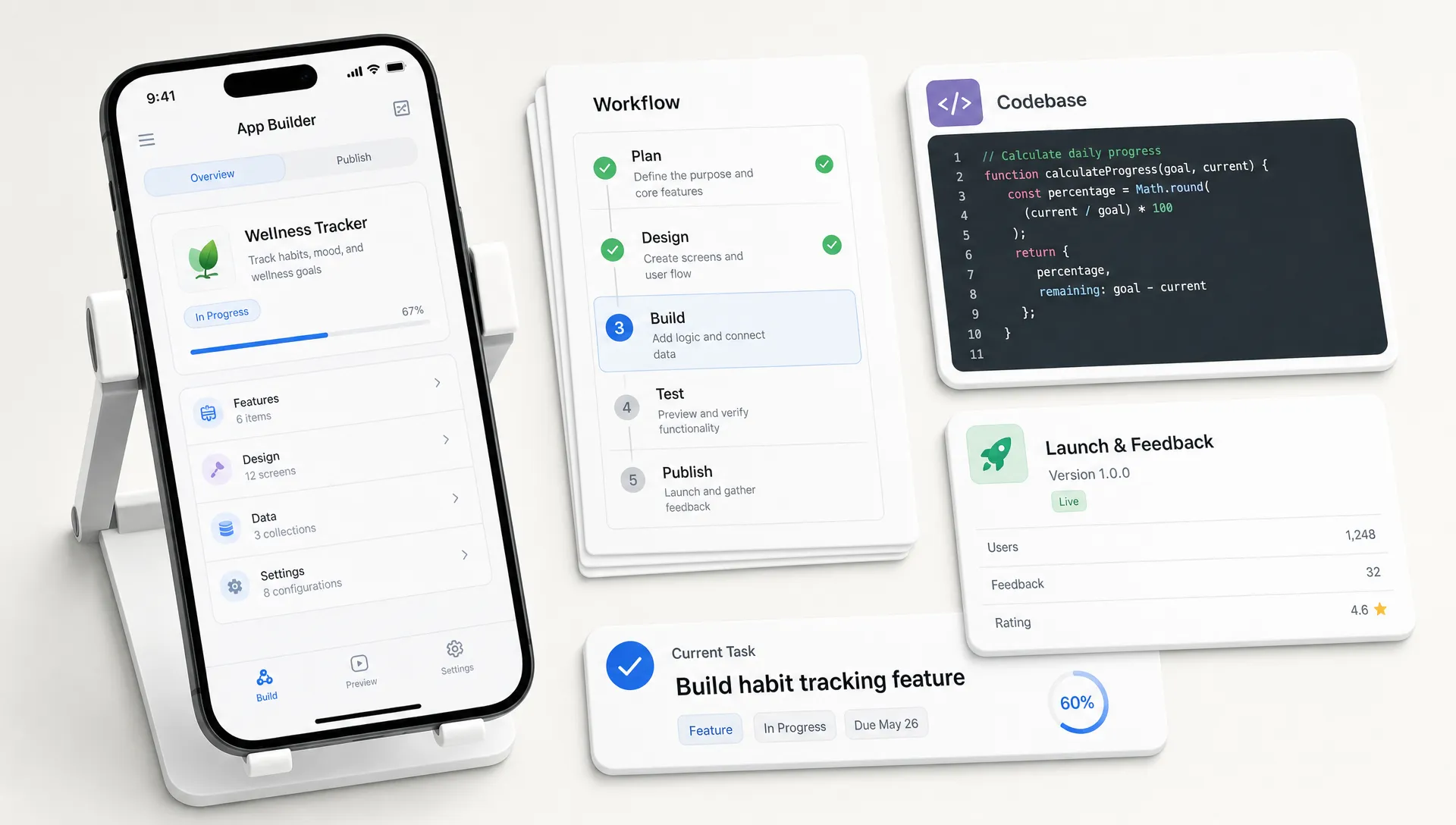

Your first startup MVP does not need every feature in your head. It needs to prove one clear thing: that real users will complete a valuable workflow often enough to justify building more.
That is where Flutter app development can make sense. Instead of funding separate iOS and Android builds before you know what users want, you can launch a focused mobile product from one shared codebase, test it with early users and iterate without doubling the development effort.
A Flutter application is not automatically cheap, fast or successful. Scope still matters. Design still matters. Backend decisions still matter. But for many early-stage founders, Flutter gives you a practical way to get a polished MVP into the hands of users without treating each platform as a separate project.
Why Flutter is popular for startup MVPs
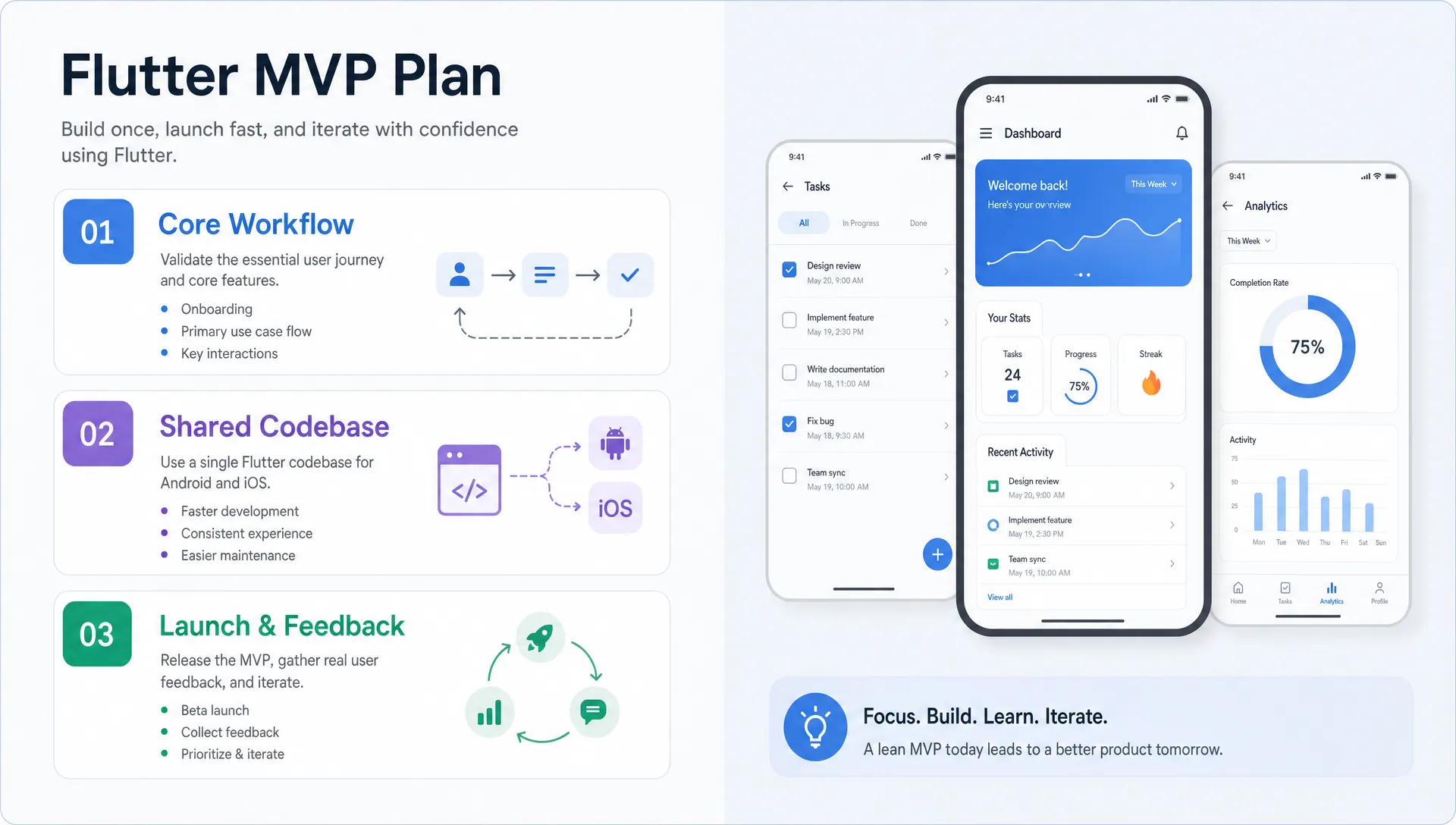
Flutter is an open-source UI toolkit created by Google for building apps across platforms from a single codebase. It uses the Dart programming language and provides its own rendering engine, which helps teams create consistent interfaces across iOS and Android. The official Flutter documentation describes it as a way to build apps for mobile, web and desktop from one codebase, although most startup MVPs begin with mobile first.
For a founder, the appeal is simple: you can validate your idea on both major mobile platforms without hiring two separate native teams. That matters when your budget is limited, your market is uncertain and your product direction may change after the first few user interviews.
Flutter is especially useful when the MVP depends on a clean interface, structured user flows and common mobile features like accounts, forms, lists, chat-style screens, booking flows, notifications or dashboards. Many local service apps, fitness products, learning tools, healthcare portals and internal operations apps fall into this category.
If you are still comparing options, this deeper guide on when a Flutter mobile app is the right choice is a useful next step. For this article, the focus is narrower: how to think about Flutter when you are building your first MVP.
What a Flutter MVP should actually include
The biggest mistake first-time founders make is treating the MVP as a smaller version of the full product. That usually creates a bloated first build with too many edge cases, too many user roles and too many screens.
A better MVP answers one core question. For example, can homeowners book a trusted cleaner in under two minutes? Can patients complete intake forms before arriving at a clinic? Can students use an AI study companion three times per week? Can a field technician update job status from a phone instead of sending texts to the office?
Your first Flutter application should be designed around that one question. Every feature either supports the test or waits for a later release.
A lean MVP usually includes these building blocks:
- A simple onboarding flow that gets the right user into the app quickly
- One primary workflow, such as booking, tracking, messaging, learning or reporting
- Basic account management, only if the product needs saved user data
- A lightweight admin or operations process, even if it is partly manual at first
- Analytics or event tracking so you can see what users actually do
- A feedback channel for early users
Notice what is missing: complex referral systems, advanced personalization, multiple payment models, deep automation and every possible admin setting. Those may become important later, but they should not slow down the first validation cycle unless they are central to the business model.
Flutter does not replace MVP strategy
Flutter helps you build faster across platforms, but it will not decide what you should build. Before you open a design tool or ask for an estimate, define the business outcome.
For a startup, the outcome might be user activation, paid preorders, completed bookings, provider signups or reduced manual admin work. For a small business, it might be fewer phone calls, faster job updates or cleaner customer records.
This is why scope should come before technology. If you have not already mapped your MVP, use a practical process like scoping an MVP app in six steps before committing to development. A focused scope makes Flutter more valuable because the shared codebase is working toward a clear launch goal, not absorbing random feature requests.
Here is a simple way to separate MVP features from later improvements:
| Feature question | MVP answer | Later version answer |
|---|---|---|
| Does the user need this to complete the core workflow? | Build it | Improve it after launch |
| Does the business need this to deliver the service manually? | Build the minimum | Automate later |
| Is this mainly for convenience or polish? | Usually wait | Add after usage data |
| Does this reduce a major compliance, safety or trust risk? | Consider early | Strengthen over time |
| Is this based on a guess, not user evidence? | Test manually first | Build if demand is proven |
This table is deliberately strict. A first MVP is not a feature showcase. It is a learning tool wrapped in a usable product.
When a Flutter application is a strong fit
Flutter is a strong fit when the product needs a high-quality mobile experience on both iOS and Android, especially when the early version does not rely on highly specialized native capabilities.
Good MVP candidates include appointment booking apps, delivery coordination tools, customer portals, habit trackers, study apps, lightweight social features, field service workflows and internal business apps. These products tend to share common patterns: forms, lists, calendars, maps, notifications, media uploads, user profiles and status updates.
A Flutter application can also work well for AI-enabled products where the mobile app is the interface and the heavy AI work happens through APIs or backend services. For example, the app might let users upload notes, receive study prompts, generate summaries or interact with a structured assistant. Flutter handles the mobile experience while the backend manages data, models and business logic.
For local businesses and field service teams, the appeal is often operational. A mobile app can replace paper forms, scattered spreadsheets and long text-message chains with a single workflow that staff can use on the job. Flutter is useful here because owners often have mixed device environments. Some employees use iPhones, others use Android devices and the business cannot control every phone in the field.
When Flutter may not be the best first choice
Flutter is flexible, but it is not the answer to every startup problem. If your app depends heavily on low-level native APIs, advanced Bluetooth behavior, complex background processing, real-time 3D graphics or platform-specific experiences that must feel completely custom on each operating system, native iOS and Android development may be more appropriate.
Flutter can integrate with native code, but those integrations add complexity. The more your MVP depends on custom native modules, the less you benefit from the speed of a shared codebase.
You should also be careful if your first release only targets one platform for a clear business reason. For example, if every early customer uses iPhones because you are selling to a specific enterprise team, a native iOS MVP might be reasonable. On the other hand, if you expect a mixed user base or do not yet know which platform will dominate, Flutter can reduce the risk of choosing wrong.
The practical question is not “Is Flutter good?” The better question is “Does Flutter help this specific MVP reach users faster without creating technical debt we cannot manage?”
The technical pieces behind your first Flutter MVP
Non-technical founders often think of the app as the whole product, but a real MVP usually includes several connected parts. Flutter covers the mobile interface and a portion of the app logic, but you still need to think through backend services, databases, authentication and deployment.
A typical MVP might include:
- Flutter mobile app for iOS and Android
- Backend API for business logic and data access
- Database for users, records, bookings, messages or app content
- Authentication for sign up, login and permissions
- File storage for images, documents or uploads
- Push notifications, if timely updates are part of the workflow
- Analytics for usage, activation and drop-off points
Some products can start with managed backend tools. Others need a custom backend from day one. The right choice depends on your data model, compliance requirements, growth plans and how much flexibility the product needs.
Healthcare products need extra care. A Flutter application can be part of a HIPAA-conscious or GDPR-conscious system, but Flutter alone does not make software compliant. Compliance depends on the data you collect, where it is stored, how access is controlled, whether vendors sign the right agreements, how logs are handled and how user consent is managed. If your MVP touches protected health information or sensitive personal data, compliance needs to be discussed before development starts.
A realistic 4 to 6 week Flutter MVP plan
A focused MVP can often be built in a 4 to 6 week window, but only when the scope is disciplined. If the first release includes multiple user types, payment flows, admin dashboards, custom AI behavior and compliance-heavy workflows, it may need more time.
For a lean first version, a practical timeline can look like this:
| Phase | Main focus | Founder involvement |
|---|---|---|
| Week 1 | Confirm scope, user flow, data needs and technical approach | Make decisions quickly and provide examples |
| Week 2 | Create core UI, app structure and backend foundation | Review screens and clarify edge cases |
| Weeks 3 to 4 | Build main workflow, integrations and key user states | Test weekly builds and give focused feedback |
| Week 5 | QA, bug fixes, analytics, app store preparation and beta testing | Invite early testers and track issues |
| Week 6 | Launch support, final fixes and next-step planning | Review usage data and prioritize version two |
This schedule assumes the MVP has one primary workflow and a clear definition of done. The timeline becomes less predictable when features are still being debated mid-build.
If you have not validated demand yet, pause before starting development. You can often reduce risk with interviews, landing pages, clickable prototypes or manual concierge tests. This guide on validating your app idea before building an MVP explains how to check whether people want the product before you invest in code.
What affects the cost of Flutter app development
There is no useful flat price for a startup MVP because two apps with the same number of screens can have very different complexity. A five-screen booking app with payments, roles, scheduling rules and notifications is harder than a ten-screen content app with mostly static information.
The biggest cost drivers are usually the number of user roles, backend complexity, integrations, custom design needs, compliance requirements and how much admin tooling is needed for the business to operate after launch.
For example, a simple customer-only app is usually easier than a marketplace with customers, providers and admins. A workout tracker with local data is usually easier than a healthcare workflow involving sensitive records, permission levels and audit considerations. An AI-powered feature may be straightforward if it calls an existing API, but more complex if it requires custom data pipelines, prompt management, safety checks and ongoing monitoring.
A good developer should help you reduce scope without weakening the MVP test. That may mean replacing a complex admin dashboard with a controlled spreadsheet process for the first launch, delaying social sharing or using manual approval instead of building full automation immediately.
How to keep your first Flutter build lean
The best way to keep a Flutter MVP lean is to make tradeoffs explicit. Do not ask whether a feature is “nice to have.” Almost every feature is nice to have. Ask whether the MVP test fails without it.
A strong first build usually has a short list of success metrics. For a booking app, that might be completed bookings and repeat use. For a lead generation app, it might be qualified submissions and response time. For an internal operations app, it might be fewer missed updates and less time spent reconciling paperwork.
You can also protect the scope by agreeing on a version one feature list before development begins. Changes will still happen, but they should be treated as tradeoffs, not additions. If something new comes in, something else should move out or the timeline should change.
For your first Flutter application, the goal is not to make the app feel unfinished. The goal is to make it focused. A narrow product that solves one painful problem is more convincing than a broad app where every feature feels half-built.
What to look for in a Flutter developer
A Flutter developer for an MVP should understand more than widgets and animations. For a startup, you need someone who can translate a business idea into a practical build plan, identify risky assumptions and make sensible technical decisions without overengineering.
Look for experience with cross-platform development, API integration, app store release processes and clean code structure. If your product involves regulated data, field operations or AI automation, the developer should be comfortable discussing constraints early instead of treating them as afterthoughts.
Communication matters as much as code during an MVP. Weekly demos, clear priorities and fast feedback loops help prevent surprises. A founder should not disappear until launch day, and a developer should not build quietly for weeks without showing progress.
I work with startups and clients on iOS and Android apps, with a focus on cross-platform builds, clean code and fast MVP delivery. If you are considering Flutter for a startup product, you can book a consultation call to review the offer.
Ready to plan your Flutter MVP?
If you are building your first startup MVP, start with the smallest product that can prove real demand. Flutter can help you move faster across iOS and Android, but the biggest gains come from clear scope, practical technical choices and a launch plan built around user feedback.
If you want help turning your idea into a focused mobile MVP, book a consultation call and discuss what belongs in version one, what can wait and whether Flutter is the right fit for your product.